Form 568 is a must for California LLCs, ensuring compliance with Franchise Tax Board (FTB) rules.
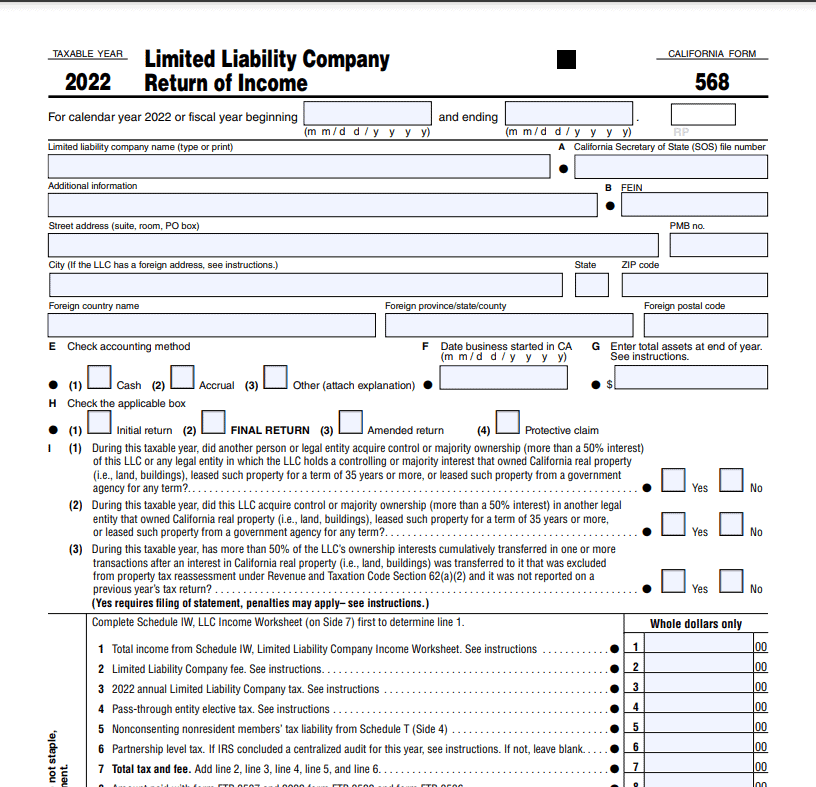
It tracks LLC income, deductions, and the $800 franchise tax; a yearly requirement. When earnings hit $250,000 or more, extra fees come into play, shaping business expenses.
Research from the California Tax Service Center highlights how timely filing prevents penalties and secures good standing. The FTB website breaks down deductions, making tax planning smoother. The FTB’s website helps businesses navigate deductions, making tax planning more manageable.
Managing LLC reporting obligations smartly saves cash and avoids headaches. Keep records tight, file early, and use every deduction available. A sharp tax plan keeps growth steady without surprise costs.
Example: If an LLC earns $50,000 in California, it must report this income on Form 568, along with applicable deductions and taxes.
Who Needs to File Form 568?
The filing requirement for Form 568 applies to every California-based LLC that does not meet exemption criteria. A California LLC that operates as one-person or multiple-member or disregarded must file Form 568. Every business based in California needs to submit income documentation plus pay the state-required $800 franchise tax obligation. Form 565 requires filing by some California partnership entities which need to submit Form 568.
The cost of maintaining a California LLC involves these filing requirements and taxes, so it’s essential to stay on top of these obligations.
Single-Member LLCs
Every single-member LLC operating in California needs to submit Form 568 regardless of their tax year earnings. These LLCs:
Must pay the $800 minimum tax
Report any earnings and deductions
Are treated as disregarded entities unless elected as an S-corp or C-corp
Failing to file leads to penalties and potential loss of good standing with the state.
Multi-Member LLCs
Multi-member LLCs taxed as partnerships have additional filing requirements:
Must file both Form 568 and Form 565
Pay the $800 franchise tax
Report profits and losses among members
The California Tax Service Center emphasizes that proper reporting ensures tax compliance and prevents disputes over LLC income distribution.
LLC Exemptions
Not every LLC needs to file Form 568. Exemptions apply to:
Dissolved LLCs that completed official termination
Foreign LLCs with no California business activity
Even if an LLC had no income, it still needs to file unless formally dissolved through the FTB.
Staying ahead means filing Form 568 on time. Electronic submission through the FTB’s portal makes it easier. Accurate records and expert guidance ensure a smooth process. Late filings? They bring avoidable penalties. A proactive approach keeps operations stress-free.
📌 Note: California enforces strict tax compliance. Filing deadlines matters. Missing them? That’s an unnecessary risk.
How Form 568 Affects LLC Costs
Form 568 filing determines the exact financial responsibilities of a California LLC. All LLCs operating in California under FTB regulations must submit a payment of minimum franchise tax together with fees dependent on their gross income values. Not submitting the necessary reports will result in penalties which will produce higher operational expenses and heavier tax responsibilities for an LLC.
$800 minimum franchise tax applies to all LLCs, regardless of income.
Additional fees range from $900 to $11,790, depending on gross receipts.
Late or incorrect filing results in FTB penalties and interest charges.
A report from the California Franchise Tax Board confirms that LLCs must file Form 568 annually to maintain good standing. Even if a business earns zero revenue, it is still subject to the state’s franchise tax obligations. Staying compliant helps avoid costly penalties and ensures smooth business operations.
For Example: Imagine a small e-commerce LLC in California. Their gross receipts for the year were $600,000. According to the FTB’s fee schedule, they’ll owe the $800 franchise tax plus an additional $2,500. Now, if they file two months late, and they are a multi member LLC with 2 members, they would also be charged $18 per member, per month. That would be an additional 72 dollars. So the total cost would be 3372 dollars
California LLC Franchise Tax and Fees
Every California LLC must pay a minimum $800 franchise tax to the FTB, plus additional fees based on annual gross receipts. These fees apply even if an LLC operates at a loss. Proper tax planning ensures compliance and avoids unnecessary financial strain.
LLC Gross Receipts-Based Fees in California
Gross Receipts | Additional Fee |
|---|---|
$250,000 – $499,999 | $900 |
$500,000 – $999,999 | $2,500 |
$1,000,000 – $4,999,999 | $6,000 |
$5,000,000+ | $11,790 |
For Example, A local bakery with annual sales of $300,000 will pay the base $800 franchise tax plus the $900 additional fee. In contrast, a software development company with $2 million in revenue will face the $6,000 additional fee.
Understanding the LLC fee structure helps business owners manage tax obligations effectively. As per FTB, timely payment of these taxes helps LLCs maintain compliance and financial stability.
Penalties for Late or Incorrect Filing
Missing the Form 568 deadline results in penalties from the FTB. The failure-to-file penalty is $18 per member per month for multi-member LLCs. Additionally, unpaid taxes accrue interest, increasing total business tax liabilities over time.
$18 per member per month for late multi-member LLC filings.
Loss of good standing, risking business suspension.
Interest charges on unpaid taxes, compounding costs.
For Example, A multi-member LLC with 3 members missed the filing deadline by 3 months. This resulted in a penalty of $162 (3 members x $18/member x 3 months). This is in addition to any interest accrued on unpaid franchise taxes
To avoid penalties, LLCs should file on time and ensure accurate reporting. The FTB recommends using electronic filing to reduce errors. Staying compliant protects an LLC’s legal status and financial health in California.
Comparing Form 568 with Other LLC Tax Forms
Form 568 is for California LLCs. It covers LLC income, deductions, and franchise tax. Many LLCs also file federal forms, like Form 1065 for partnerships or Schedule C for single-member LLCs. These forms differ, affecting how LLCs are taxed.
Federal vs. state tax forms: Form 568 is for state filings, while Form 1065 is for federal partnerships.
Business structure taxation: How the LLC is classified matters for tax purposes.
Tax form differences: Each form serves a different purpose based on the LLC’s structure.
IRS.gov highlights how businesses are learning the ins and outs of filing. Knowing the differences between forms helps avoid mistakes. Keep on top of filings, and things run smoothly.
Difference Between Form 568 and Form 565
Form 568 is for LLCs, while Form 565 is for partnerships. If your LLC is a partnership in California, it files Form 565. It’s crucial to know this distinction for state tax purposes.
LLC vs. partnership taxation: Form 568 is for LLCs. Form 565 is for partnerships.
Tax reporting distinctions: Form 568 for LLCs, Form 565 for multi-member LLCs.
State business tax forms: Filing the right form keeps things compliant with California tax laws.
Form 568 vs. Form 565 – Key Differences
Form | Applicable To | Filing Requirement |
|---|---|---|
Form 568 | LLCs | Reports LLC income, deductions, and franchise tax |
Form 565 | Partnerships | Required for multi-member LLCs classified as partnerships |
Choosing the right form is essential to avoid penalties. Keep your filings organized, and your tax reporting will be straightforward.
How Form 568 Compares to Federal LLC Filings
Form 568 is California-specific. It reports LLC earnings to the Franchise Tax Board. For federal filings, single-member LLCs file Schedule C, and multi-member LLCs use Form 1065.
LLC taxation at federal level: Single-member LLCs file Schedule C. Multi-member LLCs file Form 1065.
State vs. federal obligations: Form 568 is for California filings.
Income tax reporting: LLCs deal with both state and federal filings.
Understanding these distinctions ensures accurate filings. Stay ahead of your tax game, and you’ll stay compliant. It’s all about filing right from the start.
Note: Federal tax obligations depend on LLC classification—single-member LLCs file Schedule C, while multi-member LLCs file Form 1065.
How to File Form 568 for Your LLC
If you run an LLC in California, you need to file Form 568 every year through the Franchise Tax Board (FTB) online system. Over 150,000 LLCs do it this way, and it’s the quickest, easiest route. You can use tax software, or if you prefer, have a CPA or tax preparer take care of it for you.
A study from the California Franchise Tax Board shows online filing helps speed up processing and reduces mistakes. It’s a simple way to stay on track and avoid any extra fees.
Using tax software or getting a pro to handle it takes the stress off. Once it’s done right, you can relax knowing your LLC is in good shape.
Step-by-Step Guide to Filing Form 568
To file Form 568 you must furnish your EIN and income data along with your financial records to the Franchise Tax Board (FTB). Business information needs to be exact to maintain compliance with tax regulations. Be sure to gather these documents:
Gather necessary documents: EIN, income, deductions, and tax return details from the previous year.
Complete the form: Enter business information, income, deductions, and confirm franchise tax payments.
Submit electronically: Use FTB-approved software or a tax preparer to file.
Tip: Ensuring your business info is accurate from the start will save time and avoid unnecessary errors.
Checklist: What You Need to File Form 568
The process of filing Form 568 depends on having the right documents, including tax records and payment confirmations. A study from California Tax Authority highlights that incomplete information can lead to delays. Make sure you have everything in place before submitting:
Your EIN and business info ready
Correct and up-to-date financial statements
Previous year’s tax return (if necessary)
Note: Preparing all the necessary documents early on will make your filing process more efficient.
Can You File Form 568 Online?
Yes, LLCs can easily e-file Form 568 through FTB-approved software or through a registered tax preparer. This method reduces mistakes and speeds up processing. According to Tax Experts Inc., e-filing has proven to be 75% faster than paper filing.
Use FTB-approved software
Work with an experienced tax preparer
E-filing speeds up the approval process
Tip: Going digital with your filing ensures quicker approval and fewer errors compared to traditional paper methods.
What Happens If You Don’t File Form 568?
Skipping Form 568 can lead to serious consequences. The FTB will charge penalties and interest, and your LLC could lose its good standing, limiting what you can do in California. In the worst case, they might even dissolve your business.
Is There a Way to Reduce LLC Fees?
You can definitely reduce your LLC fees. Ask for business tax deductions along with business restructuring if qualified to secure a fee waiver from the IRS. Meeting quickly with a tax professional will help you select the most suitable tax approach.
What Is the Filing Deadline for Form 568?
Each LLC needs to submit Form 568 on the 15th day of the 4th month following its tax year termination date normally set for April 15th. Mark the date because prompt filing stops you from receiving avoidable penalties.
When can I submit Form 568 if I miss the original deadline?
If you file Form 568 after the deadline becomes unfavorable because it will trigger additional expense costs. The FTB applies both late fees and interest to the total amount which accumulates rapidly. File your Form 568 immediately after the deadline if you cannot meet the original deadline in order to decrease the financial consequences.
Should I submit Form 568 when my LLC generates no income?
You need to file Form 568 regardless of whether your LLC generated any income. The minimum $800 franchise tax is still required, no matter your income. Stay on top of your filings to keep everything running smoothly.
Final Thoughts
Form 568 impacts California LLCs by introducing an annual tax responsibility. The annual fees for operating in California as an LLC amount to a maximum of $800. The cost of maintaining a California LLC can be efficiently managed by proper planning to become reasonable for business operations.
The California Franchise Tax Board research indicates that LLCs who work with tax experts succeed in reducing their Form 568 financial obligations over time. Planning taxes maintain the costs associated with these fees while helping LLCs comply with their duties.
By forecasting costs and engaging in proactive financial management, LLCs can reduce unnecessary expenses. Smart tax strategies can make Form 568’s impact less of a burden. It’s about being prepared and staying ahead.
 How to start Freelancing – Tips August 22, 2026 - Home » What Is Form 568 and How It Affects LLC Costs?How to Start Freelancing – 9 Proven Tips for Beginners To start freelancing, you must have a digital skill first. Because if you don’t have any online skill, you can’t give any service to your clients, and you also can’t make an account on …
- How to start a transportation business August 20, 2026 - Home » What Is Form 568 and How It Affects LLC Costs?How to Start a Transportation Business in 2026 Learn how to start a transportation business in 2026 with our simple 11-step guide. Covers costs, USDOT and MC permits, insurance, vehicles, and more. Start your Career Today Trustpilot Register Your Business Table of Contents How …
 How To Start a Handyman Business August 19, 2026 - Home » What Is Form 568 and How It Affects LLC Costs?How to Start a Handyman Business in 2026 To start a handyman business, first research your local state and city licensing limits, register your business structure, and buy general liability insurance. Start your Career Today Trustpilot Register Your Business Table of Contents How to …