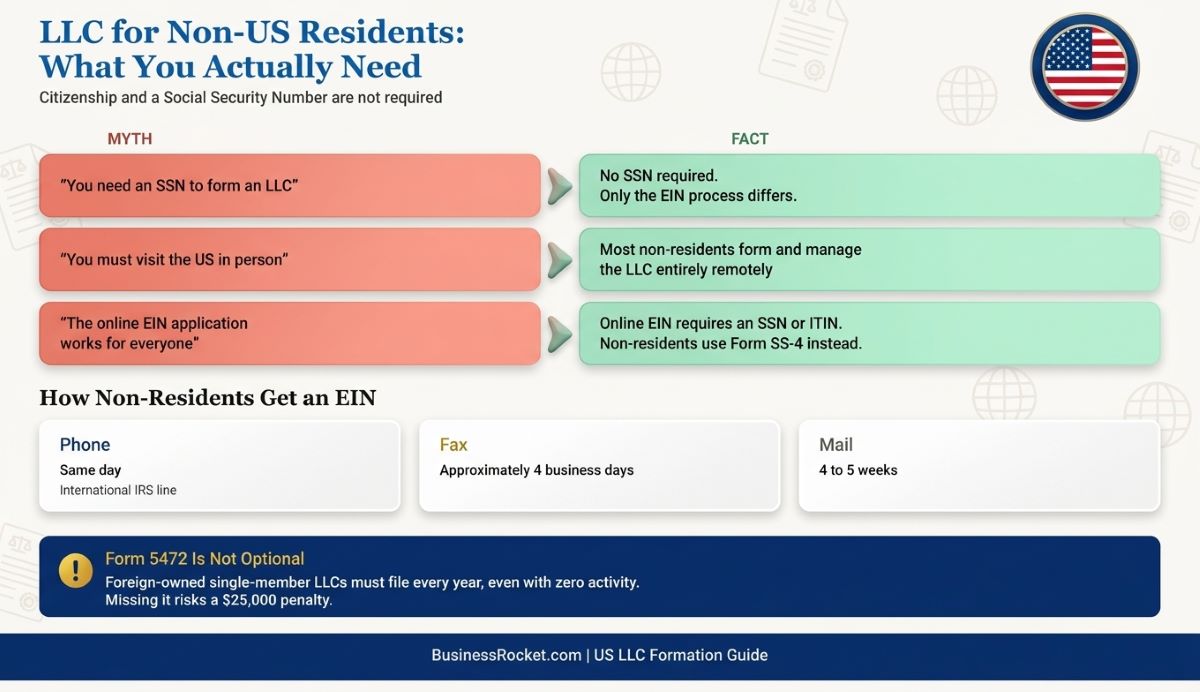
After forming your LLC, you may also need an EIN, a US bank account, and tax filings, depending on your situation. You do not need US citizenship, a Green Card, a US visa, or an SSN to form a US LLC as a non-US resident.
The IRS allows foreign-owned US LLCs, and the US has no federal citizenship requirement for LLC ownership. You can build a US business structure from abroad with the right setup.
LLCs give international businesses a clear legal structure and a professional presence in the US. Non-US residents can generally own an LLC without living in America. Once you understand the key filing and tax rules, the process becomes much easier.
This guide covers what most others skip past: formation, EIN, banking, tax exposure, and the annual filing almost everyone underestimates.
Quick Guide for US LLC Requirements for Non-US Residents
If you just want the shape of it before reading further, here is the reference table, followed by the six steps in order. Whether you are starting an LLC today, next month, or later this quarter, the sequence stays the same.
| Requirement | What Non-US Residents Should Know |
|---|---|
| LLC ownership | A non-US resident can generally own 100% of a US LLC |
| US visa | Not required simply to own an LLC |
| SSN | Generally not required to form the LLC |
| EIN | Foreign owners without an SSN or ITIN apply by fax or mail instead of the online tool |
| Registered agent | A US registered agent is required in the state where the LLC is formed |
| US business address | Banking providers may require a genuine operating address, not a registered agent address |
| Form 5472 | Required annually for certain foreign-owned LLCs when reportable transactions occur |
| US tax | Depends on the LLC’s classification, income, and business activities |
| Entity type | Most non-residents choose an LLC over a corporation for simpler compliance |
Can a Non-US Resident Legally Form a US LLC?
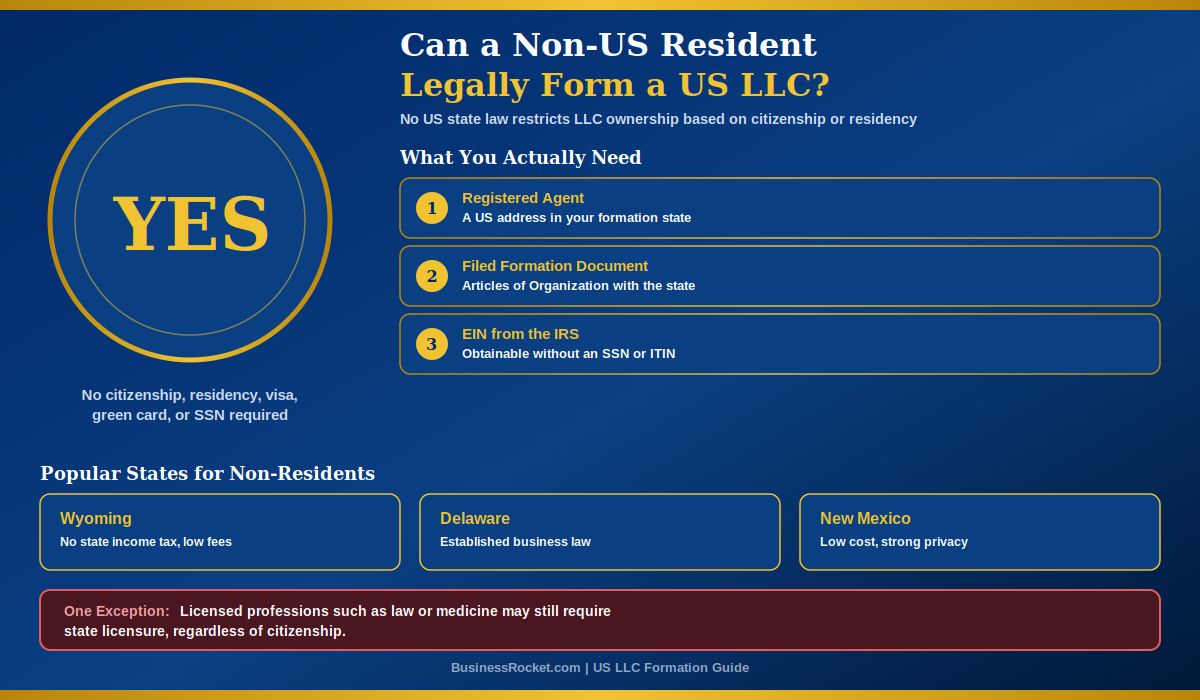
Yes. Non-US residents can form an LLC in the US without citizenship, residency, or a Social Security Number. Founders from well over a hundred countries do this every year, entirely online. Most non-US resident LLCs end up being single-member, though nothing stops multiple owners from filing together.
At the federal level, here is what you actually need:
- A state to form in, any state, not necessarily where you live or plan to sell.
- A registered agent with a physical address in that state.
- A valid ID, usually a passport.
- An EIN from the IRS, which you apply for after formation.
That is the requirement list. Immigration status is a completely separate legal matter, and forming an LLC does not give you any right to live or work in the US.
Handling a business entity and having permission to physically work inside the country are two different things, and it is a common point of confusion. In most cases, someone can own 100% of a US LLC without needing a work visa, as long as they are not personally performing labor on US soil.
Note: These terms all describe the same setup: a limited liability company owned by someone who lives outside the United States. Whether you call it an LLC for non-residents, an LLC for non-US citizens, or a US LLC owned by a foreigner, the state paperwork does not reference nationality at all. An LLC in Delaware, or a US LLC for non-residents formed in any other state, follows the identical set of rules once ownership sits outside the country.
Which State Is Best for a Non-US Resident LLC?
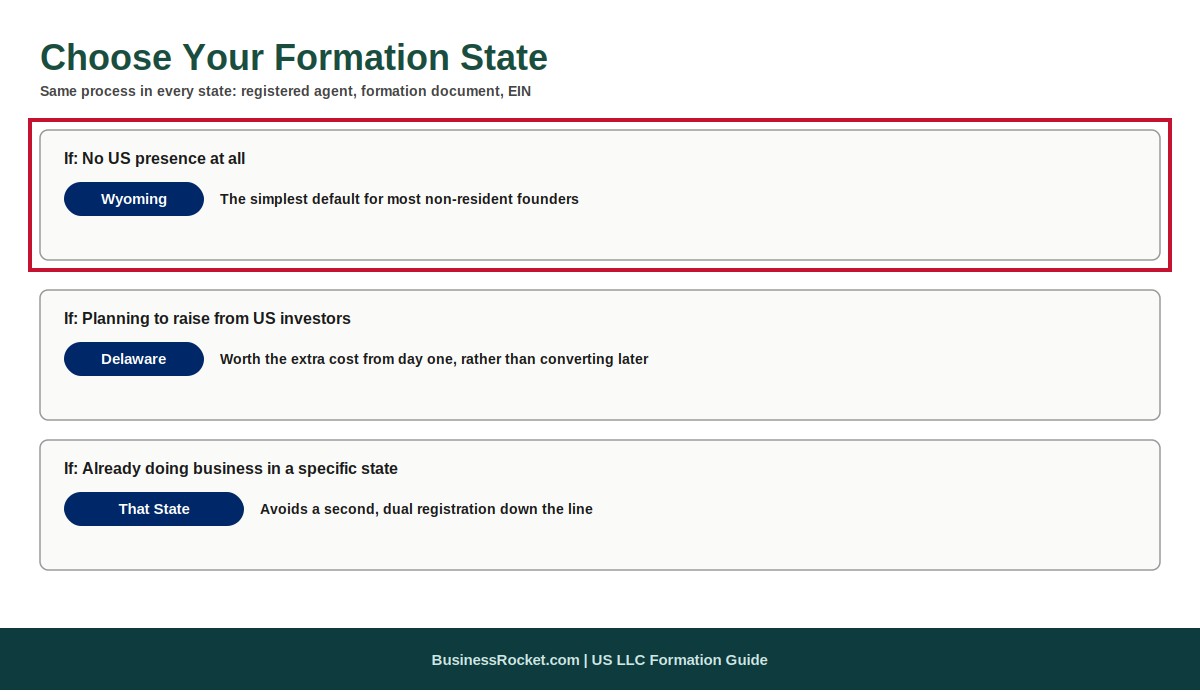
No single state is the best fit for everyone. For most non-resident founders running an online business, freelancing, consulting, or selling through platforms like Shopify or Amazon, a Wyoming LLC tends to be the practical default. It is inexpensive, private, and widely recognized by fintech banking platforms.
A Delaware LLC and its premium price tag makes more sense once venture capital is part of the plan. Between Wyoming and Delaware specifically, the honest answer usually comes down to whether outside investors are involved at all.
Wyoming vs. Delaware vs. New Mexico for Non-Residents
| Factor | Wyoming | Delaware | New Mexico |
|---|---|---|---|
| Filing fee (one-time) | $100 by mail, about $102 to $104 online | $110 | Low, varies by filer |
| Annual fee | $60 minimum, scales above $300k in-state assets | $300 franchise tax | None |
| Member privacy | Names not on public filing | Names not required | Names not required |
| Typically best for | Online businesses, no VC plans | Raising US venture capital | Lowest long-term cost |
Quick Decision Guide
| If your situation is… | Consider… |
|---|---|
| Fully remote, no US investors | Wyoming |
| Planning to raise US venture capital | Delaware |
| Prioritizing the lowest possible annual cost | New Mexico |
| Already operating physically in a specific US state | That state, to avoid dual registration |
Delaware’s reputation matters most to institutional investors, not to a solo remote founder. A New Mexico LLC and its zero annual fee is appealing on paper but less internationally recognized. Wyoming stays the default because it has the fewest friction points for banking and long-term upkeep, not because it is the cheapest line item.
Note: The registered agent must be located in the state where the business is formed, rather than a generic nationwide service. A Delaware registered agent serves only a Delaware LLC. Both Wyoming and Delaware impose no state income tax on LLC profits, though federal tax obligations are a separate consideration covered later in this guide.
How to Form a US LLC as a Non-Resident: Step by Step
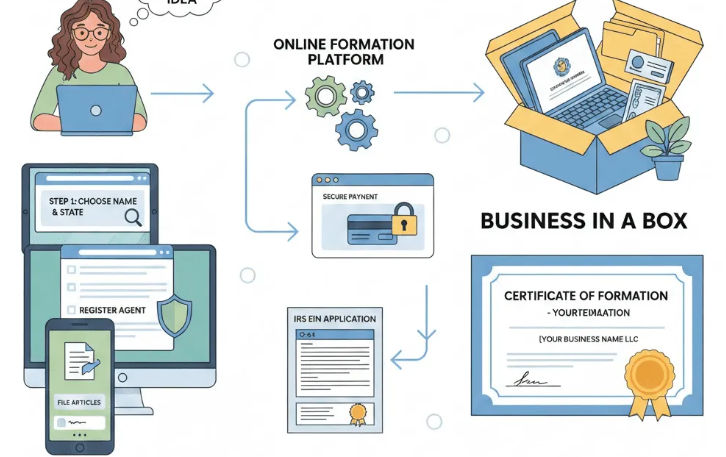
Setting up an LLC is the same regardless of state: choose a state, appoint a registered agent with a US address, file the formation document, wait for approval, then apply for an EIN. Once every document is filed correctly, the LLC is formed and ready to operate.
Step 1: Choose Your State
No US presence at all – Wyoming is usually the simplest default, and some founders form a Wyoming LLC for exactly this reason.
Planning to raise from US investors – Delaware is worth the extra cost from day one, rather than converting later.
Already doing business in a specific state – Forming your LLC there directly usually avoids a second, dual registration down the line.
Step 2: Appoint a Registered Agent
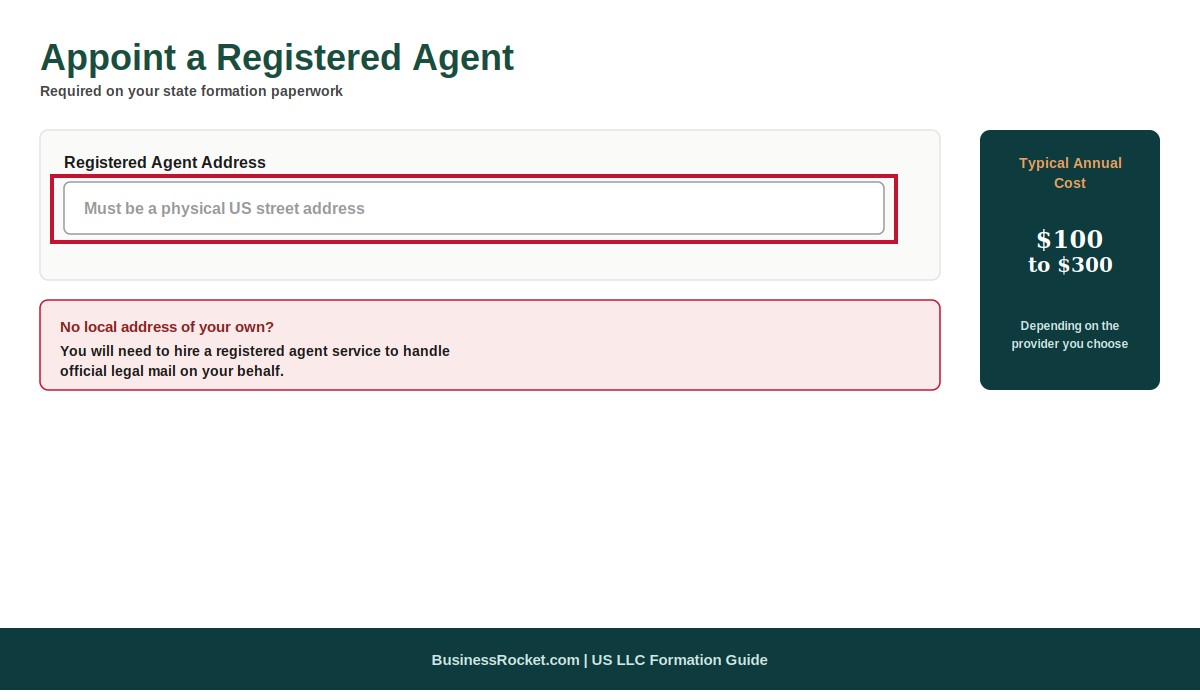
If you do not live in the US, you will not have a local physical address to put on the state paperwork. That means you will almost certainly need to hire a registered agent service to handle official legal mail for you. Expect to pay somewhere between $100 and $300 a year, depending on the provider.
Step 3: File Your Formation Document
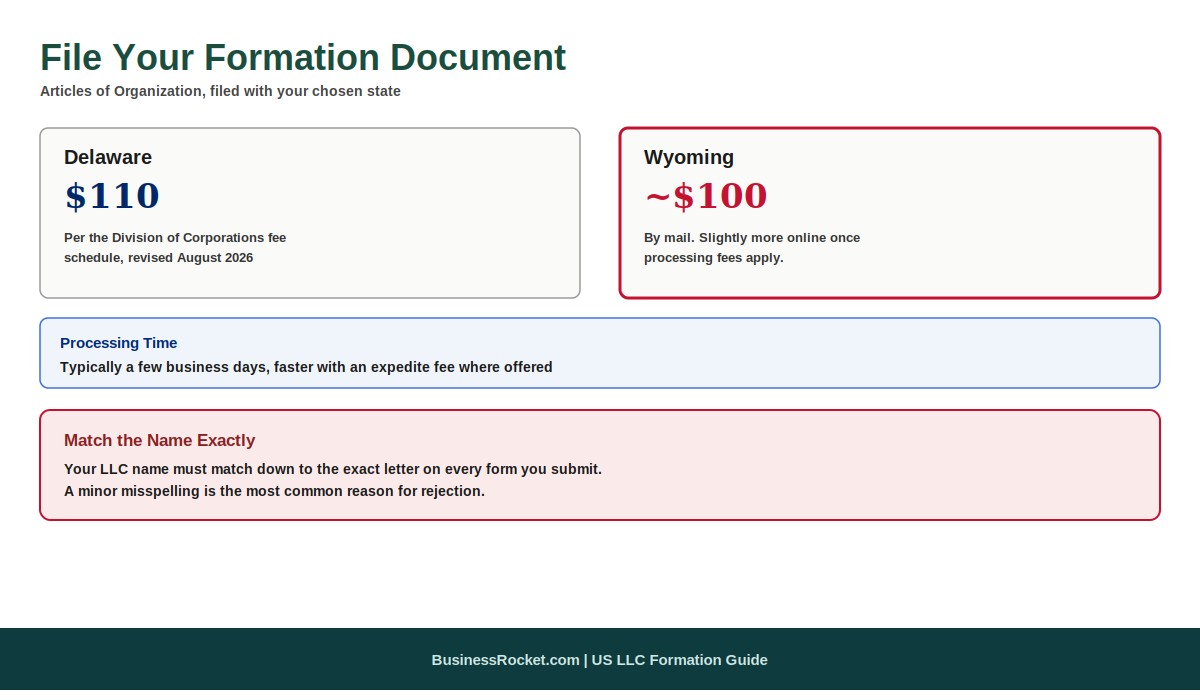
- Delaware LLC filing fee: $110, per the state’s Division of Corporations fee schedule (revised August 2026).
- Wyoming LLC filing fee: roughly $100 by mail, slightly more online once processing fees apply.
- Processing time: typically a few business days, faster with an expedite fee where offered.
Your LLC name must match down to the exact letter on every single form you submit from here on out. It is surprising how often a state office rejects a formation over one minor misspelling that could have been avoided.
Step 4: Collect Your Stamped Documents
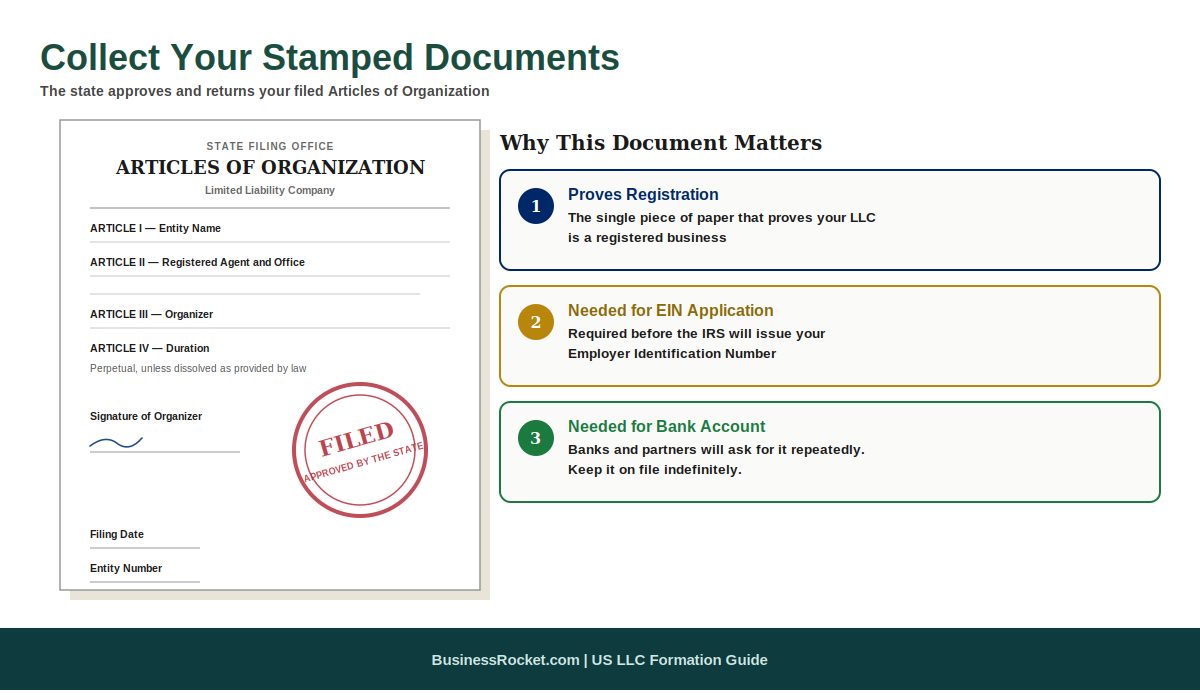
Once approved, the state sends back a stamped copy of your Articles of Organization. This single document proves your LLC is registered, so you will need it for almost every setup step after this, including your EIN application and opening a business bank account. Keep it on file indefinitely, since banks and partners will ask for it repeatedly.
Step 5: Apply for Your EIN
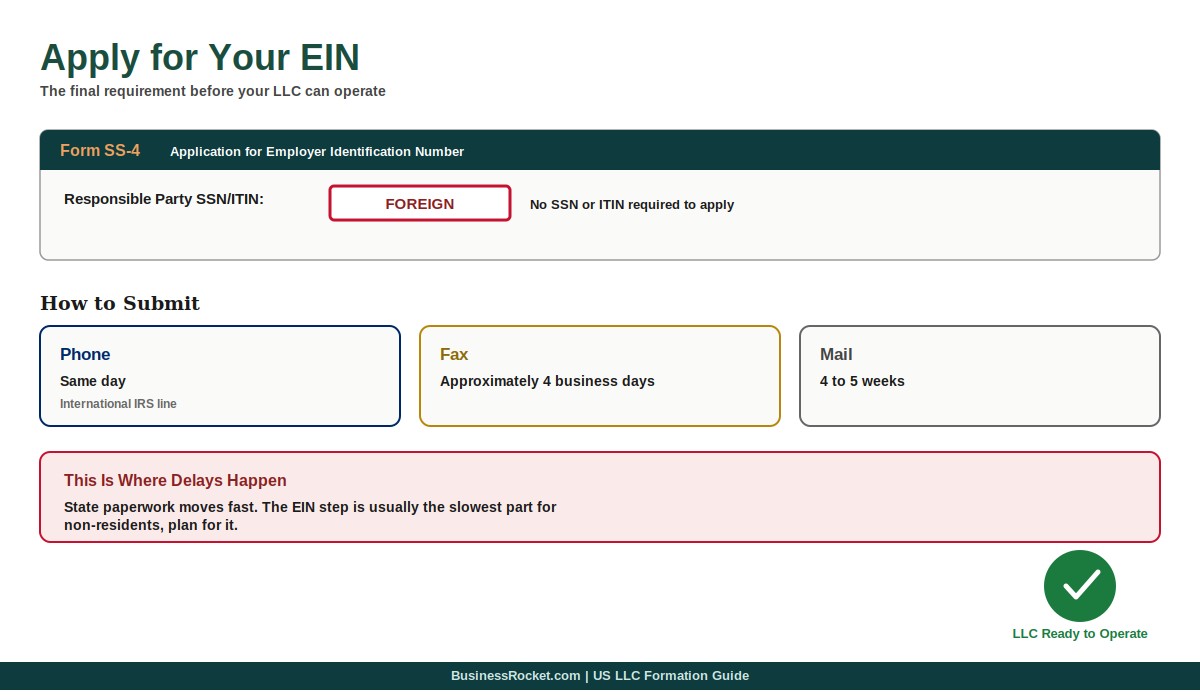
Once you have your approved formation paperwork, your LLC can apply for an Employer Identification Number from the IRS. This is the final requirement before the business can actually operate. If you want to get up and running quickly, getting this tax ID is usually where things slow down, not the state paperwork.
Example: A freelance designer working with US clients decides to formalize her business with a US LLC instead of invoicing as an individual. She picks Wyoming, hires a registered agent for $125 a year, and her Articles of Organization clear in three business days. Two weeks later, her stamped documents arrive by email. She never sets foot in the United States during the process, and her total formation cost, agent fee included, comes to under $250.
Do You Need a Registered Agent, and What Address Can You Use?
Yes, in every state. A registered agent with a physical address in the state of formation is a legal requirement, and this is often the first genuine surprise for non-resident founders.
- The agent needs a physical street address in that specific state, not a P.O. box.
- Acting as your own agent is technically possible with a qualifying address, which most non-residents do not have.
- A registered agent service fills that gap for an annual fee.
- This address exists for legal mail only, not as a stand-in for your operating address.
- An agent tied to Wyoming cannot cover a Delaware LLC, or vice versa, since coverage is state-specific.
- Multi-member LLCs still only need one registered agent, not one per member.
Using the registered agent’s address as if it were the company’s real business address tends to cause problems later, particularly during banking. Where possible, keeping a genuine operating address, even a home address in another country, separate from the legal mail address avoids that friction from the start.
How Do Non-Residents Get an EIN Without an SSN?
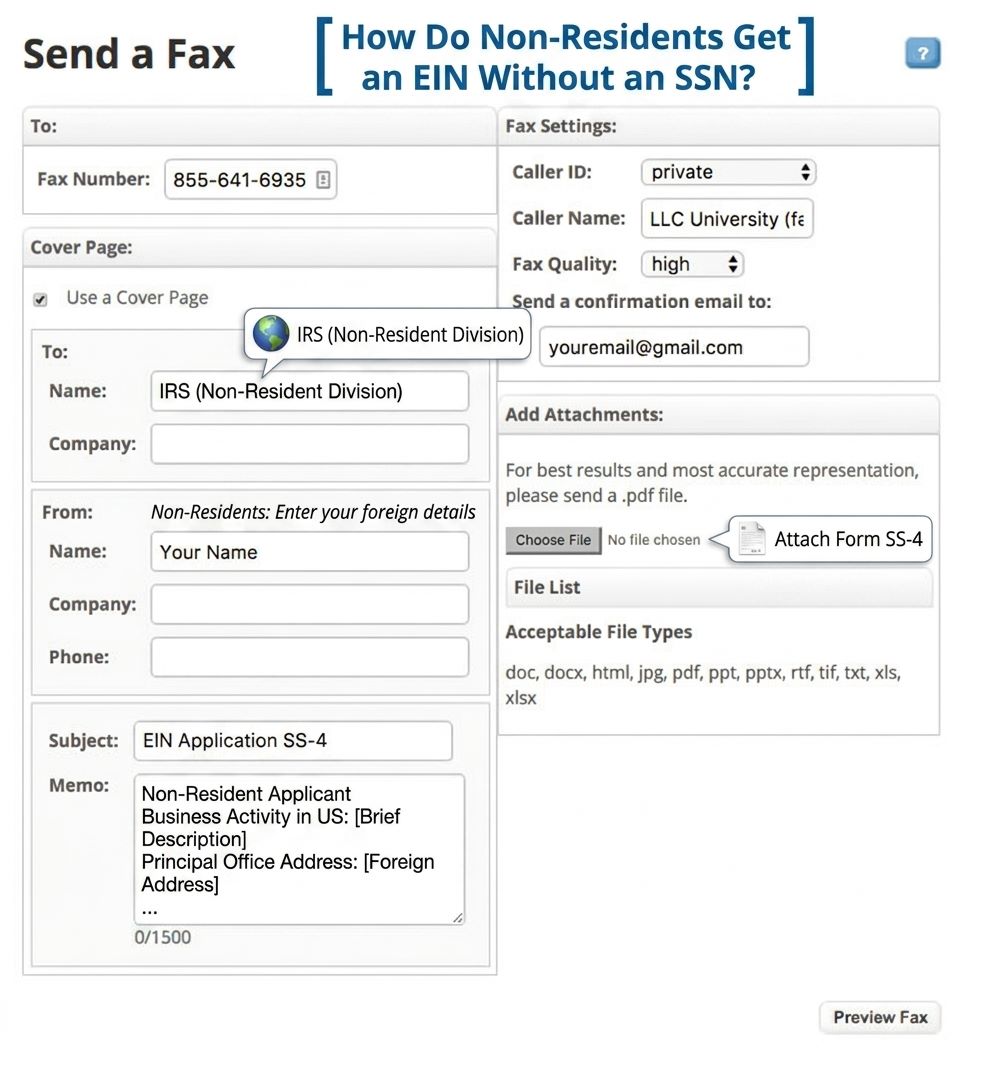
Non-US applicants who are not eligible to use the IRS online EIN application can generally complete Form SS-4 and submit it through the IRS-approved method for their situation. The online application is intended for applicants who already have the required US taxpayer identification information.
This is where formation often gets held up for non-residents, so it helps to set realistic expectations in advance.
| Method | Typical Timeline | Notes |
|---|---|---|
| Fax | 1 to 4 weeks, up to 8 during IRS backlogs | Generally the fastest realistic option |
| 4 to 5 weeks, longer with international transit | Slower and harder to track than fax | |
| Phone | Same call, in limited cases | Reserved for specific international scenarios |
| Online | Same day | Not available without an SSN or ITIN |
Two details that save weeks of delay:
- Line 7b of Form SS-4: write “Foreign” rather than leaving it blank, since a blank field is a common cause of rejection.
- Name consistency: double-check the LLC’s legal name matches the formation documents exactly, since a mismatch causes the same kind of delay.
How to Open a US Bank Account as a Non-Resident LLC Owner
The order matters: form the LLC first, get the EIN, then apply for a business bank account. Having your company documents ready makes the banking process much easier.
- Traditional banks can be harder to access. Many brick-and-mortar banks have in-person requirements or ask for additional US identification, which makes them less convenient for non-resident owners.
- Online options can be more flexible. Some financial platforms accept applications from eligible non-US founders and may let you complete the process remotely. You will generally need company formation documents, an EIN, a passport, and other verification details.
The basic sequence stays the same whether you search for a US business bank account, a business account for a non-resident, or banking for a foreign-owned LLC: form the LLC, get the EIN, then apply for the account.
Business Banking Options for Non-Residents
Mercury – A popular option for eligible US companies with non-US founders. You may need your EIN, passport, company documents, and business information.
Relay – Another option for eligible US businesses. Its requirements depend on the company and owner, so check the eligibility rules before applying.
Wise Business – Handy for businesses that move money across borders. Its multi-currency features are useful for international operations, though it is not the same as a traditional US bank account.
Note: As of 2026, Mercury’s own documentation confirms it no longer accepts a registered agent’s address as a company’s physical operating address. Mercury separates two fields: a legal address, which can be the formation address, and a physical or operating address, where registered agent addresses, P.O. boxes, and virtual mailboxes are explicitly rejected. A genuine location tied to actual operations is needed instead, even if that is simply a home address in another country.
What you will actually need:
- Relay’s document list: stamped Articles of Organization, EIN confirmation letter (CP575 or 147C), signed operating agreement, and a passport.
- On ITIN requirements: none of the major non-resident-friendly platforms currently require one, based on their published criteria as of this review.
A working bank account is often the last real gap between forming a US company on paper and gaining actual access to the US market, letting a small operation compete the same way a domestic business can, none of it requiring a US mailing address of your own.
Do Non-US Residents Have to Pay US Federal Income Tax on Their LLC?
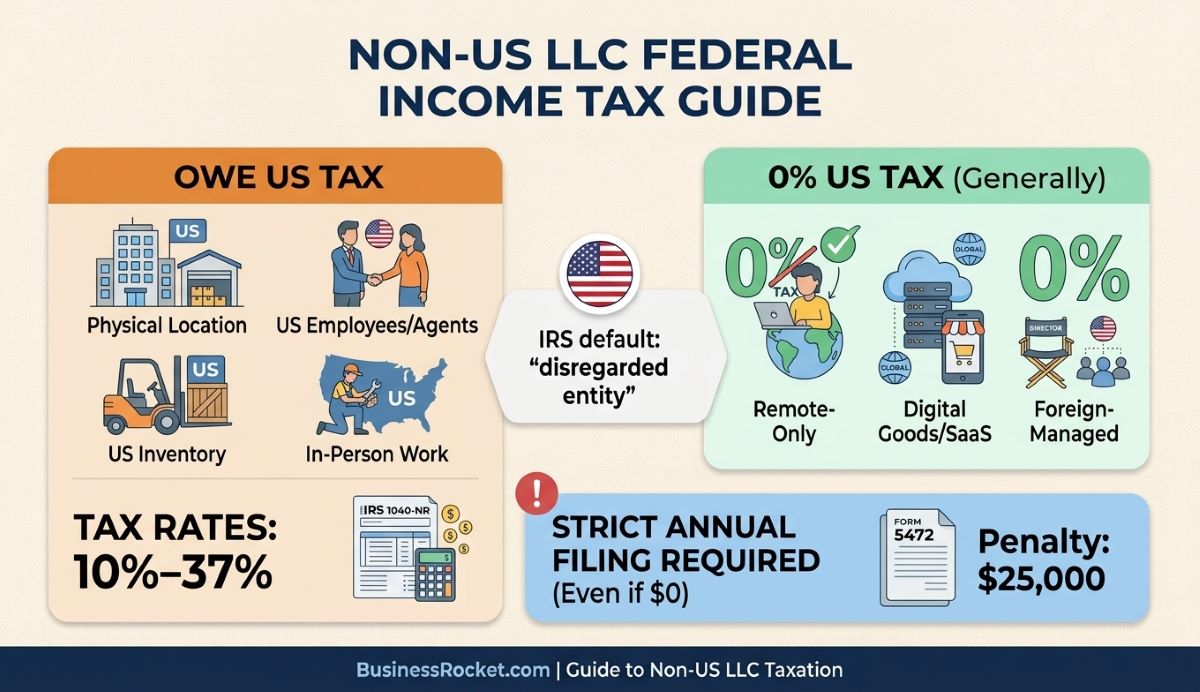
It generally comes down to two questions, asked in a specific order. This is a simplified framework, not tax advice, and situations vary enough that a licensed CPA familiar with cross-border structures is worth involving before you rely on any of this.
- Is the LLC engaged in a US trade or business? This usually means a US office, warehouse, or an employee or dependent agent working inside the country.
- If so, is the income US-sourced and effectively connected to that business?
In most cases, both questions need to come back yes before federal tax applies to the LLC’s profit. A business that runs entirely remotely, with no US office, no US employees, and no dependent agent closing deals on US soil, usually fails the first test.
What that means in practice: a foreign-owned single-member LLC in that situation can end up owing little or no US federal income tax. This is a legitimate outcome under the right facts, not a workaround, and anyone forming an LLC specifically to keep taxes at home should still confirm the details with a CPA, since facts vary case by case.
The catch worth repeating: owing no tax and having no filing obligation are not the same thing. Even at zero tax owed, a federal information form is typically still due every year, which we cover next.
What Is Form 5472, and What Changed in 2026?
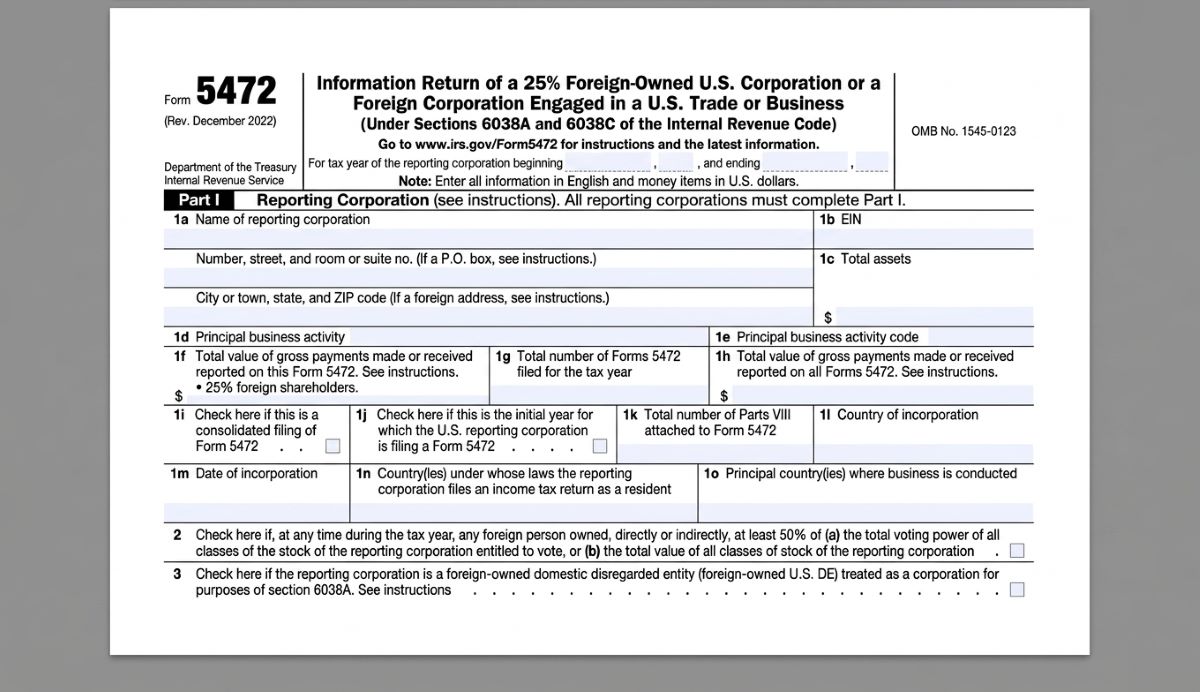
Form 5472 is an information return, not a tax bill. A foreign-owned single-member LLC treated as a disregarded entity generally has to file it annually, alongside a simplified Form 1120, whenever there is a reportable transaction between the LLC and its foreign owner.
| Question | Answer |
|---|---|
| Who must file | Foreign-owned single-member disregarded LLCs with a reportable transaction |
| What counts as reportable | Capital contributions, distributions, loans, owner-paid expenses |
| Filed alongside | A pro forma Form 1120 (name and address only) |
| Due date | April 15, with a 6-month extension available via Form 7004 |
| Minimum penalty for missing it | $25,000, per year, per form |
That $25,000 figure is not scaled to business size. The penalty generally applies per year and per form, regardless of whether any tax was owed, even if the LLC reported zero income. Assuming zero income means zero filing obligation is one of the more expensive misunderstandings a non-resident LLC owner can carry into their first year.
The 2026 OBBBA Update Most Guides Have Not Caught Yet
The One Big Beautiful Bill Act introduced a new 1% excise tax on certain cross-border remittance transfers, effective January 1, 2026. Per the IRS’s own proposed regulations released in April 2026, it applies only to transfers funded by cash, money orders, or cashier’s checks. Standard bank wires, ACH transfers, and debit or credit card funded transfers are exempt.
In practice, this means most non-resident LLC owners are likely unaffected, since capital contributions and distributions typically move through wires or ACH rather than cash instruments. Worth confirming with your own bank or advisor regardless, since early coverage made this law sound broader than the finalized scope.
Common Mistakes to Avoid When Forming a US LLC as a Non-US Resident
Forming a US LLC from abroad can be straightforward, but a few details deserve attention from the start. The issues below are easy to overlook during formation and become more important once the business is running.
| Common Mistake | What to Do Instead |
|---|---|
| Expecting the EIN to arrive immediately | Foreign applicants who cannot use the online system apply another way, which takes longer than a few days. Leave extra time in your schedule. |
| Using a registered-agent address for banking | That address is for official documents only. Have a separate operating address ready, since banks may ask for one during verification. |
| Assuming no income means no Form 5472 | Certain foreign-owned LLCs must still file when reportable transactions occur, even with little or no income. The penalty for missing it is steep. |
| Choosing Delaware without a clear reason | Delaware suits fundraising, not every founder. Forming there purely for prestige usually just means a higher annual bill for no real benefit. |
| Mixing personal and business money | Keep company funds separate from personal finances. Clean records ease accounting and preserve the line between you and the LLC. |
| Treating formation as the finish line | Approval is only the beginning. EIN, banking, tax classification, state filings, and federal reporting all still matter afterward. |
Plan for these ahead of time and they stop being problems. Most non-resident founders only ever hit one or two, usually the EIN timeline and the Form 5472 filing, simply because neither gets much attention in typical formation marketing. Getting it right the first time is the difference between a smooth first year and a stressful one.
LLC for Non-US Residents: What You Actually Need
Pulling it all together, a non-US resident LLC comes down to a short list: a formation state, a registered agent in that state, a valid passport, an EIN from the IRS, a bank account through a non-resident-friendly platform, and awareness of the annual Form 5472 filing. Handle those in order and you have a fully working US company, run entirely from abroad.


 How to start Freelancing – Tips August 22, 2026 - Home » LLC For Non-US-ResidentsHow to Start Freelancing – 9 Proven Tips for Beginners To start freelancing, you must have a digital skill first. Because if you don’t have any online skill, you can’t give any service to your clients, and you also can’t make an account on any freelancing platform because they ask for …
- How to start a transportation business August 20, 2026 - Home » LLC For Non-US-ResidentsHow to Start a Transportation Business in 2026 Learn how to start a transportation business in 2026 with our simple 11-step guide. Covers costs, USDOT and MC permits, insurance, vehicles, and more. Start your Career Today Trustpilot Register Your Business Table of Contents How to Start a Transportation Business in 2026: …
 How To Start a Handyman Business August 19, 2026 - Home » LLC For Non-US-ResidentsHow to Start a Handyman Business in 2026 To start a handyman business, first research your local state and city licensing limits, register your business structure, and buy general liability insurance. Start your Career Today Trustpilot Register Your Business Table of Contents How to Start a Handyman Business in 2026: A …