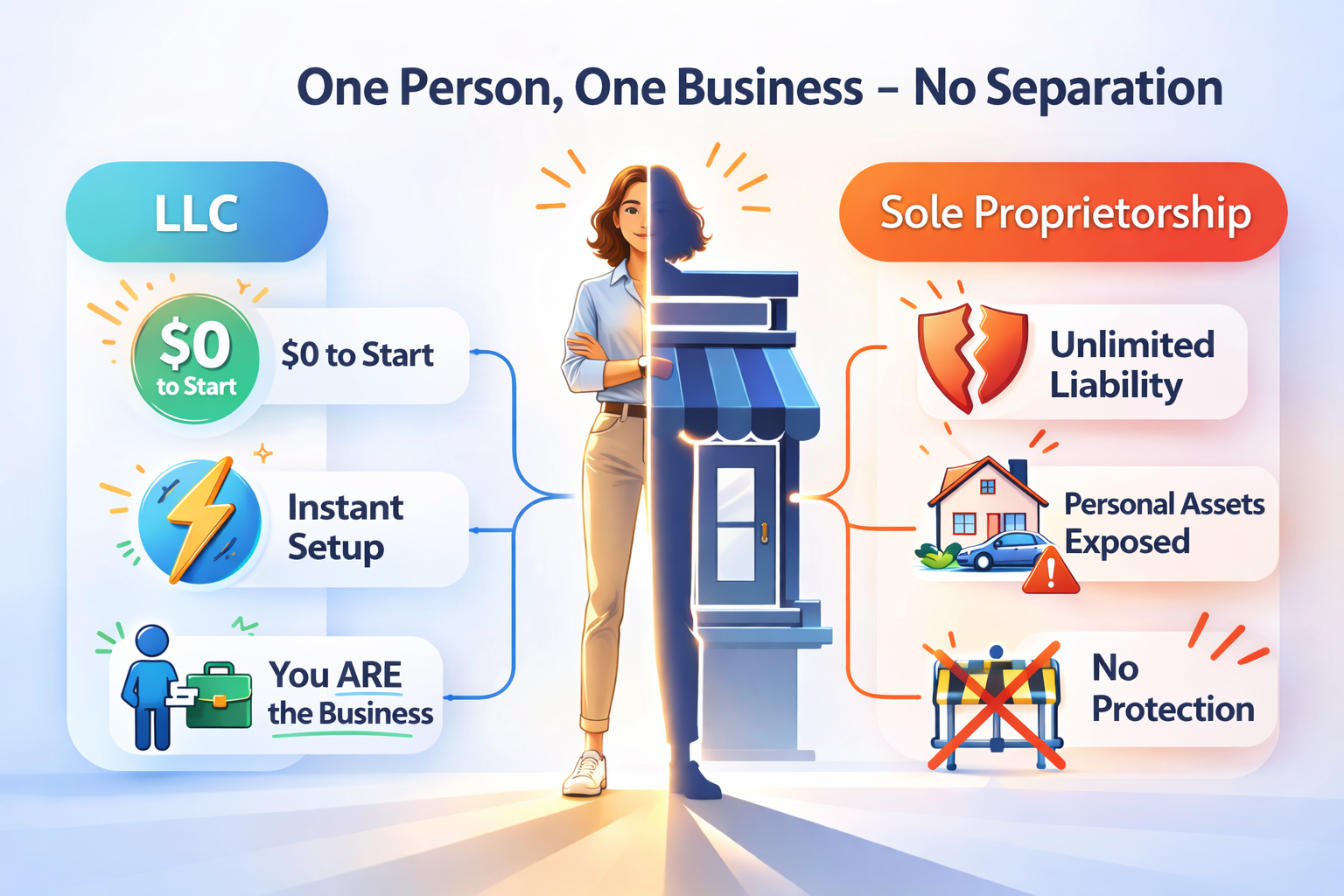
What Is a Sole Proprietorship?
A sole proprietorship is the simplest type of business structure where you start a business and automatically operate as a sole proprietor.
To establish a sole proprietorship, you need exactly zero registration, no documents, no state fees, no formal process. You begin working and earning income, you’re already operating as a sole proprietorship.
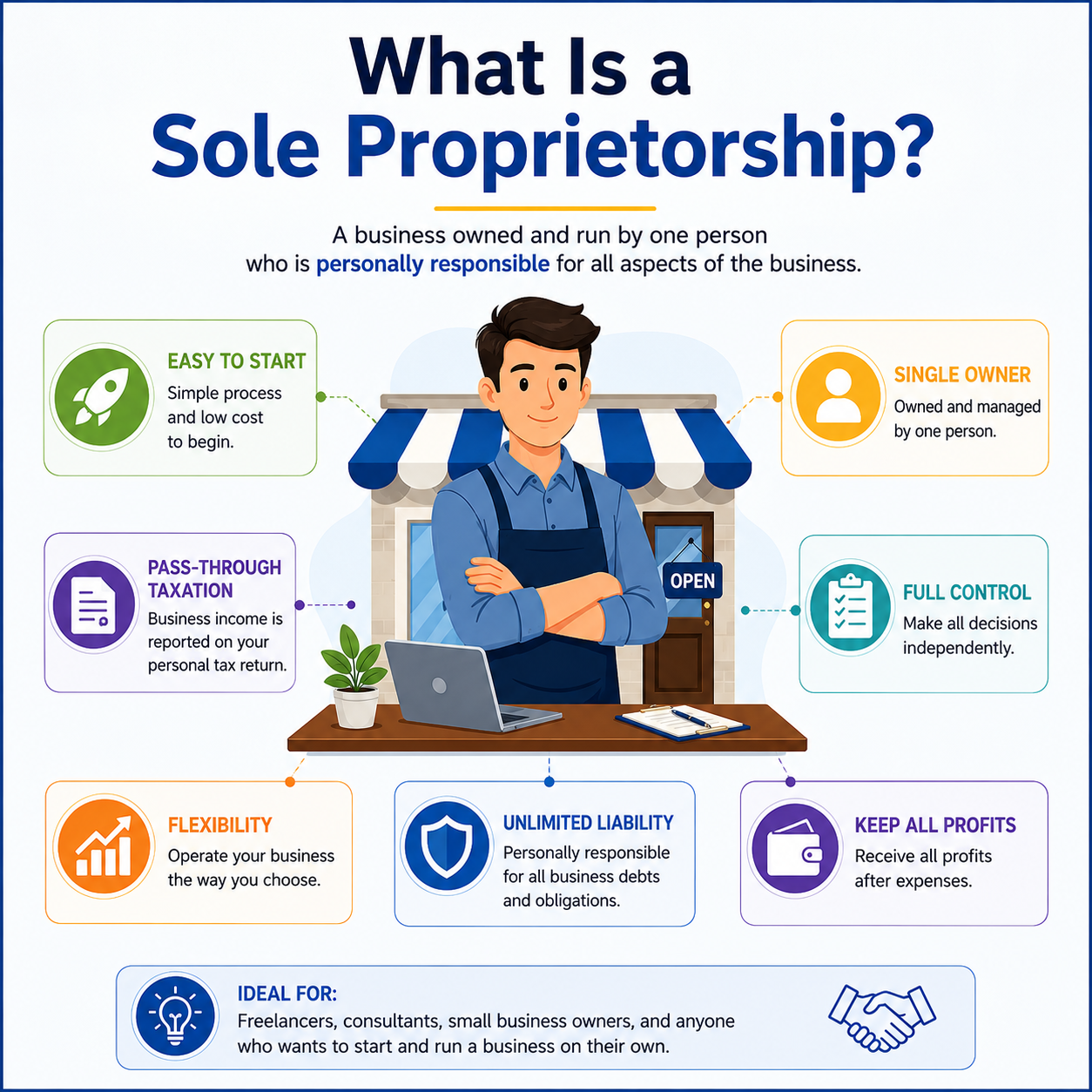
Technically, sole proprietorships aren’t separate business entities at all. A proprietorship is an unincorporated business that’s legally identical to its owner. The sole proprietorship is an unincorporated structure where business assets equal personal assets completely. This makes sole proprietorship easy and sole proprietorship quick to launch, perfect for testing a business idea.
When you register your business informally this way, you become the sole owner with complete control but unlimited liability. Many small business owners start here because sole proprietorships are ideal for low-risk ventures requiring minimal investment.
Common Sole Proprietorship Examples
Freelancers, consultants, photographers, tutors, dog walkers, landscapers, and independent contractors typically operate as sole proprietorships.
How Sole Proprietorship Works
Zero Formation Requirements: Sole proprietorship is easy because you start a business immediately without any registration paperwork required.
No Legal Separation: You and the business represent one business entity. Business and personal finances aren’t separated. Business and personal assets are identical legally. Business debts equal personal debts. Business income equals personal income tax liability.
Pass-Through Taxation: When taxed as a sole proprietorship, report business profits and losses on your personal tax return Schedule C. No separate business tax return needed. Simple reporting but zero tax flexibility.
Unlimited Personal Liability: Your home, car, savings, and all personal assets are exposed to any business debts or lawsuits. Banks rarely lend to sole proprietorships without personal guarantees because the sole owner assumes 100% risk.
Single Owner Only: Cannot have partners. Adding a second owner converts you to sole proprietorship or partnership structure automatically.
DBA Naming Option: File “Doing Business As” to use trade name. Costs $25-$100 but provides zero liability protection.
What Is an LLC? Why Limited Liability Companies Protect Your Business and Personal Assets
LLC is a separate legal entity registered with the state that creates a clear wall between you and your business. File Articles of Organization with your state, pay the filing fee, and your business becomes its own legal person. Creditors can only chase LLC business assets. Your personal home, savings and car stay completely protected.
NOTE: Even though an LLC does not pay federal income tax itself, you still pay taxes on business profits. The LLC does not pay entity-level taxes, profits “pass through” to you and you report on your personal tax return.
How LLCs Protect Business and Personal Assets
Think of an LLC as a protective legal shield separating business and personal finances. When setting up an LLC, you create two-step ownership: You own the LLC. The LLC owns the business. This separation means LLC may protect your personal wealth from business creditors and lawsuits.
Example: Your LLC owes $200,000 to creditors. They can seize the LLC’s $15,000 business bank account, equipment, and receivables. But they cannot touch your $300,000 personal home, $50,000 personal savings, or personal vehicles. Your maximum loss = whatever you invested into the LLC.
LLC Ownership Flexibility Options
Single-Member LLC: One owner (member). Default taxation matches sole proprietorship but LLC provides full liability protection a sole proprietorship lacks completely.
Multi-Member LLC: Two or more LLC members sharing ownership. Split profits however you want. When choosing the right business structure for partnerships, multi-member LLC gives everyone personal liability protection.
Tax Strategy Power: Make $40K+ profit? Elect S-Corp taxation and save thousands in self-employment tax annually. Sole proprietorships can’t access this ever.
LLC: Pros and Cons
Pros
Liability protection: An LLC (Limited Liability Company) protects personal assets because it creates a legal separation between the owner and the business. This reduces personal risk in case of business debt or lawsuits, which is a key advantage in higher-risk businesses.
Flexible taxation: An LLC allows different tax options under IRS rules, including pass-through taxation and S Corporation election. This flexibility exists because LLCs are adaptable structures, which can help reduce overall tax burden.
Business credibility: An LLC improves business credibility with clients, banks, and investors. This happens because registered entities are considered more professional, which can increase trust and access to funding.
Scalability and growth: An LLC supports business expansion by allowing multiple members and flexible management structures. This makes it easier to grow, add partners, and scale operations over time.
Cons
Higher setup cost: Forming an LLC requires state registration fees, which can range from $50 to $500 depending on the state. This increases the initial cost compared to simpler structures.
Ongoing compliance: An LLC requires annual filings and regulatory compliance. This creates additional administrative work and responsibility for business owners.
Sole Proprietorship: Pros and cons
Pros
Easy setup: A sole proprietorship is the simplest way to start a business because it requires little to no registration. This allows individuals to begin operations quickly.
Low cost: This structure has minimal startup cost, often close to $0, since no formal registration is required in most cases.
Full control: The owner has complete control over all business decisions. This provides flexibility and fast decision-making without involving partners.
Simple taxation: A sole proprietorship follows pass-through taxation, where income is reported on the owner’s personal tax return. This simplifies tax filing under IRS rules.
Cons
No liability protection: A sole proprietorship does not provide liability protection, meaning the owner is personally responsible for all business debts and legal obligations. This increases financial risk.
Limited funding access: It is harder to secure loans or investors because this structure lacks formal credibility, making it a higher-risk option for financial institutions.
Which business structure should you choose LLC or Sole Proprietorship
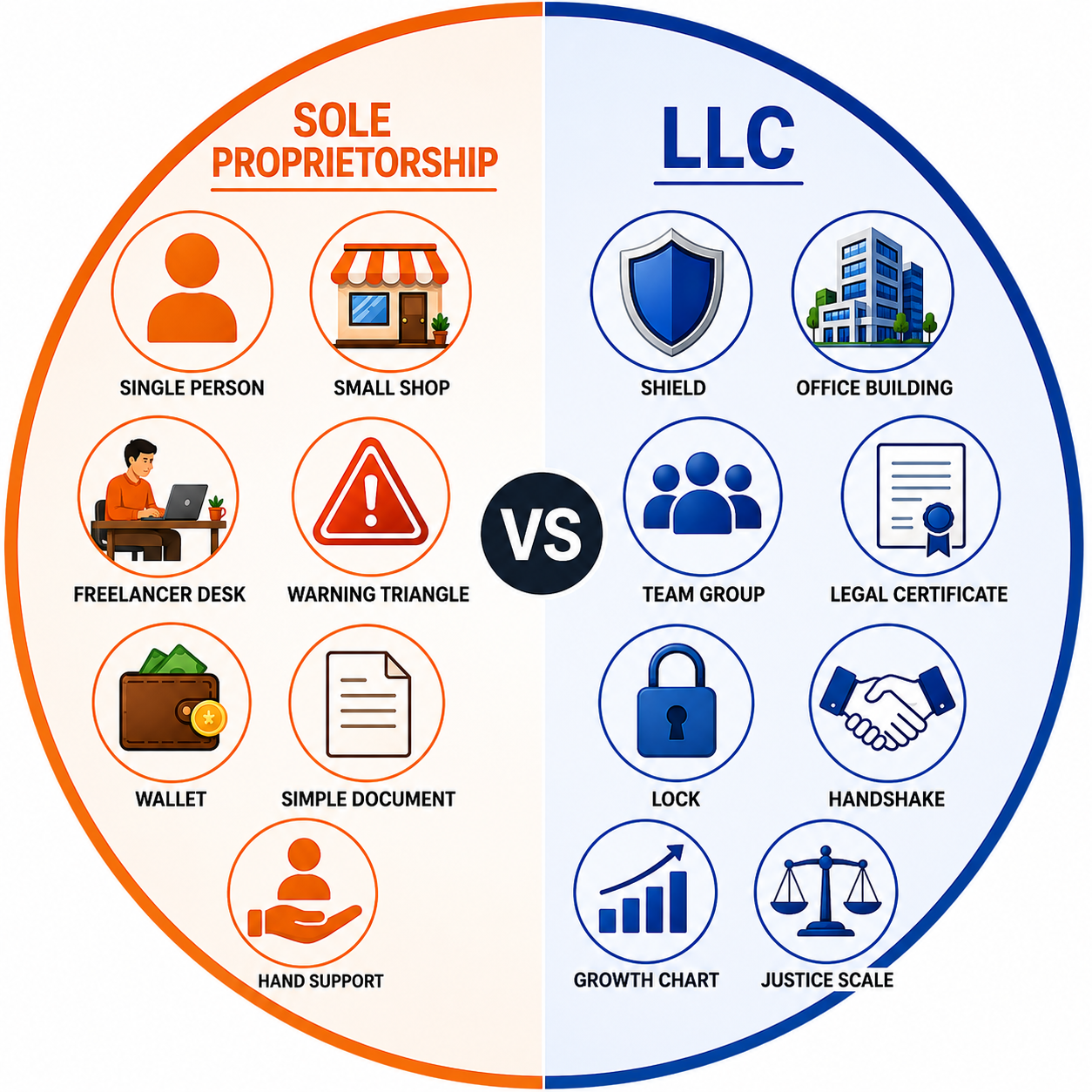
The better choice between a Sole Proprietorship or LLC depends on your business needs, risk level, and future goals. Both structures are used for different situations, which is why one is not always better than the other.
- Choose a Sole Proprietorship if:
→ You want to start quickly with zero cost
→ You are testing a business idea
→ You have low liability risk
→ You are a freelancer or part time worker - Choose an LLC if :
→ You need personal asset protection
→ You plan to grow long term
→ You want tax flexibility through IRS
→ You are earning $40,000 or more annually
How to Switch from a Sole Proprietorship to an LLC
Every USA state has its own procedures for switching from a sole proprietorship to an LLC. Research your specific state requirements before starting. If you wish to keep the same brand name you may need to cancel your existing DBA name before forming your LLC.
Starting as sole proprietorship then converting to LLC later is perfectly acceptable strategy. Many entrepreneurs test business idea viability first before incurring LLC costs and compliance.
Conversion Process
- Start an LLC by filing Articles of Organization with your state
- Obtain new EIN from IRS (recommended)
- Open a business bank account under LLC name
- Transfer business assets/licenses to LLC ownership
- Update contracts, agreements, vendor accounts to LLC name
- Notify clients and update marketing materials
- File final Schedule C for sole proprietorship year
- Begin filing LLC tax returns going forward
Timing Considerations: Convert mid-year or wait until calendar year end for cleaner tax reporting transition. Consult CPA for optimal timing.
Tax Implications: Generally no tax consequences from converting. Assets transfer at existing basis. Consult tax professional for complex situations.
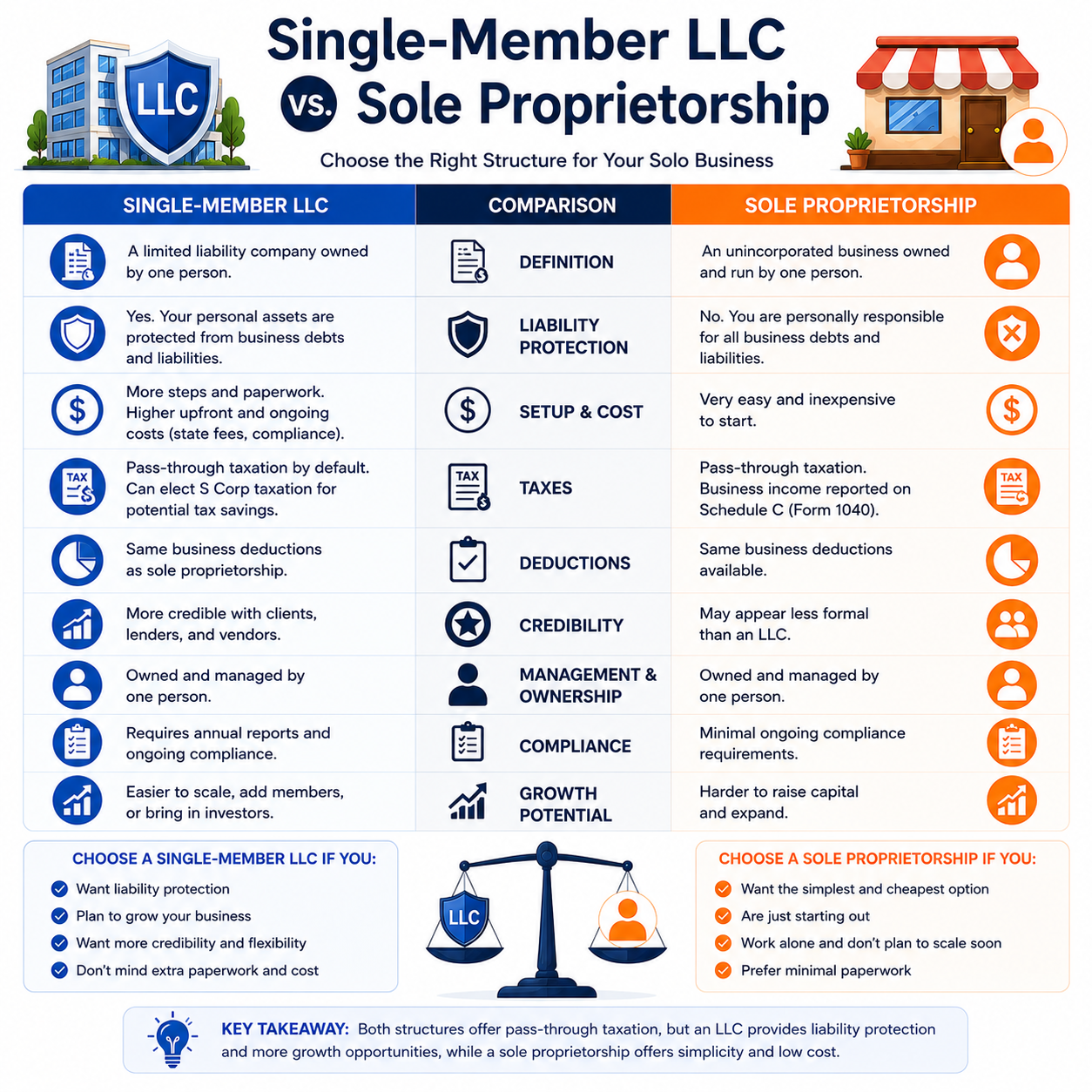
Both sole proprietorship and an LLC are “pass-through entities” by default business profits and losses flow through to your personal tax return. But when evaluating LLC vs sole proprietorship tax implications, the flexibility difference matters enormously.
The sole proprietorship vs LLC tax question centers on flexibility rather than default treatment. Let’s examine how each structure for your business handles taxes in 2026.
Sole Proprietorship Taxes Explained
When taxed as a sole proprietorship, add Schedule C to your 1040 personal tax return.
Example:
- Business profit: $80,000
- Self-employment tax: $12,240 (15.3%)
- Then STILL owe income tax on top
Self-Employment Tax Breakdown:
- 12.4% Social Security
- 2.9% Medicare
- Total: 15.3% on your business income
W-2 employees split this with employers. As a sole proprietor? You pay taxes on the FULL 15.3%.
NOTE: Above $200K single/$250K married, add 0.9% Medicare tax. Quarterly tax returns required or face penalties.
Zero flexibility this is your only option.
Single-Member LLC Default Tax Treatment
By default, single-member LLCs are taxed as a sole proprietorship. IRS treats them as “disregarded entities” for tax purposes. File Schedule C same as sole proprietors would on personal tax return.
Same 15.3% self-employment tax applies to LLC profits by default. Same QBI deduction eligibility. Same quarterly estimated tax returns requirements. Same personal income tax treatment.
Key Difference: LLCs can elect alternative tax treatments sole proprietorships cannot access. This tax flexibility becomes valuable as your right business grows and generates higher profits allowing strategic tax planning.
LLC S-Corp Tax Election Advantage
LLCs can elect S-Corporation taxation by filing Form 2553 with the IRS. This election can reduce self-employment tax significantly once profits exceed $40,000-$50,000 annually.
How S-Corp Taxation Works:
- Pay yourself “reasonable salary” subject to payroll taxes
- Take remaining profits as “distributions” NOT subject to self-employment tax
- Save 15.3% self-employment tax on distribution amounts
Example: $100,000 LLC profit with S-Corp election:
- Pay $60,000 salary (subject to payroll tax)
- Take $40,000 distribution (NOT subject to self-employment tax)
- Tax Savings: $6,120 annually (15.3% × $40,000)
Sole proprietorships cannot elect S-Corp treatment. This option requires LLC or corporation status, giving LLC major tax advantage.
Multi-Member LLC Tax Treatment
Two+ member LLCs taxed as partnerships by default. File Form 1065 partnership tax returns plus issue K-1s to each LLC members showing profit/loss share for their personal tax return.
Can also elect S-Corp or C Corporation treatment if beneficial. Unlike C Corporation facing double taxation on corporate profits then dividend distributions, LLC owners maintain pass-through benefits unless explicitly electing corporate taxation.
Tax Deductions: Same for Both Business Structures
Both sole proprietors and LLC owners claim identical business expense deductions on tax returns:
- Home office deduction
- Vehicle expenses (standard mileage or actual)
- Equipment and supplies
- Professional services fees
- Marketing and advertising
- Business insurance premiums
- Retirement contributions (SEP-IRA up to $72,000 for 2026)
The LLC vs sole proprietorship structure doesn’t change what you can deduct, only reporting method and tax flexibility options differ.
How to Set Up Your LLC vs Starting a Sole Proprietorship
The process to set up your LLC versus establish a sole proprietorship differs dramatically in complexity, cost, and ongoing compliance. Here’s how each business structure handles formation.
Starting a Sole Proprietorship
Formation Steps: Literally zero. Start a business earning income = you’re a sole proprietorship automatically. The sole proprietorship is quick to launch because the sole proprietorship is easy with no formal requirements.
Optional DBA Filing: File “Doing Business As” to use trade name ($25-$100 typically).
Business License: Some cities/counties require general business license ($25-$100 annually).
EIN from IRS: Not required if you have no employees. Can use Social Security Number. However, getting EIN recommended to avoid identity theft risks.
Total Formation Cost: $0-$200 maximum
Ongoing Annual Requirements: Renew business license if applicable. File Schedule C with tax returns. That’s it.
Forming an LLC
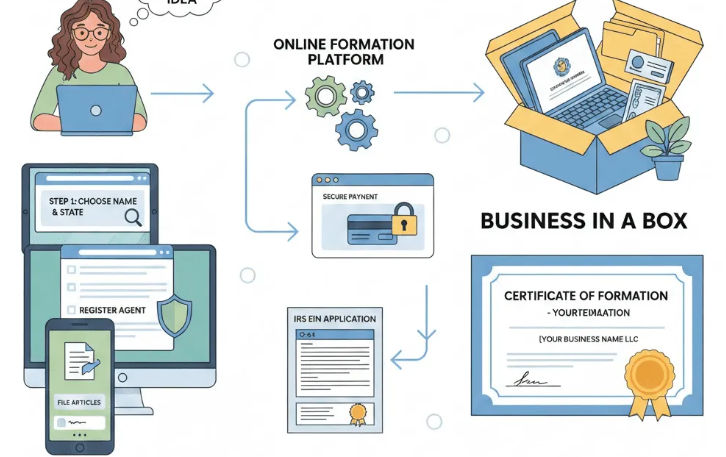
Formation Steps to Set Up Your LLC:
- Choose unique LLC name including “LLC” or “Limited Liability Company”
- File Articles of Organization with Secretary of State
- Pay filing fee ($50-$500 depending on state)
- Appoint Registered Agent with physical state address
- Create Operating Agreement (recommended)
- Obtain EIN from IRS (required for multi-member, recommended for single-member)
- Open a business bank account (required to maintain separation)
- File initial reports if state requires
Total Formation Cost: $50-$500 state fee + $100-$300 Registered Agent + $0-$500 attorney fees if hiring professional
Ongoing Annual Requirements:
- Annual or biennial report filing ($50-$300 state-dependent)
- Registered Agent fees ($100-$300 annually if using service)
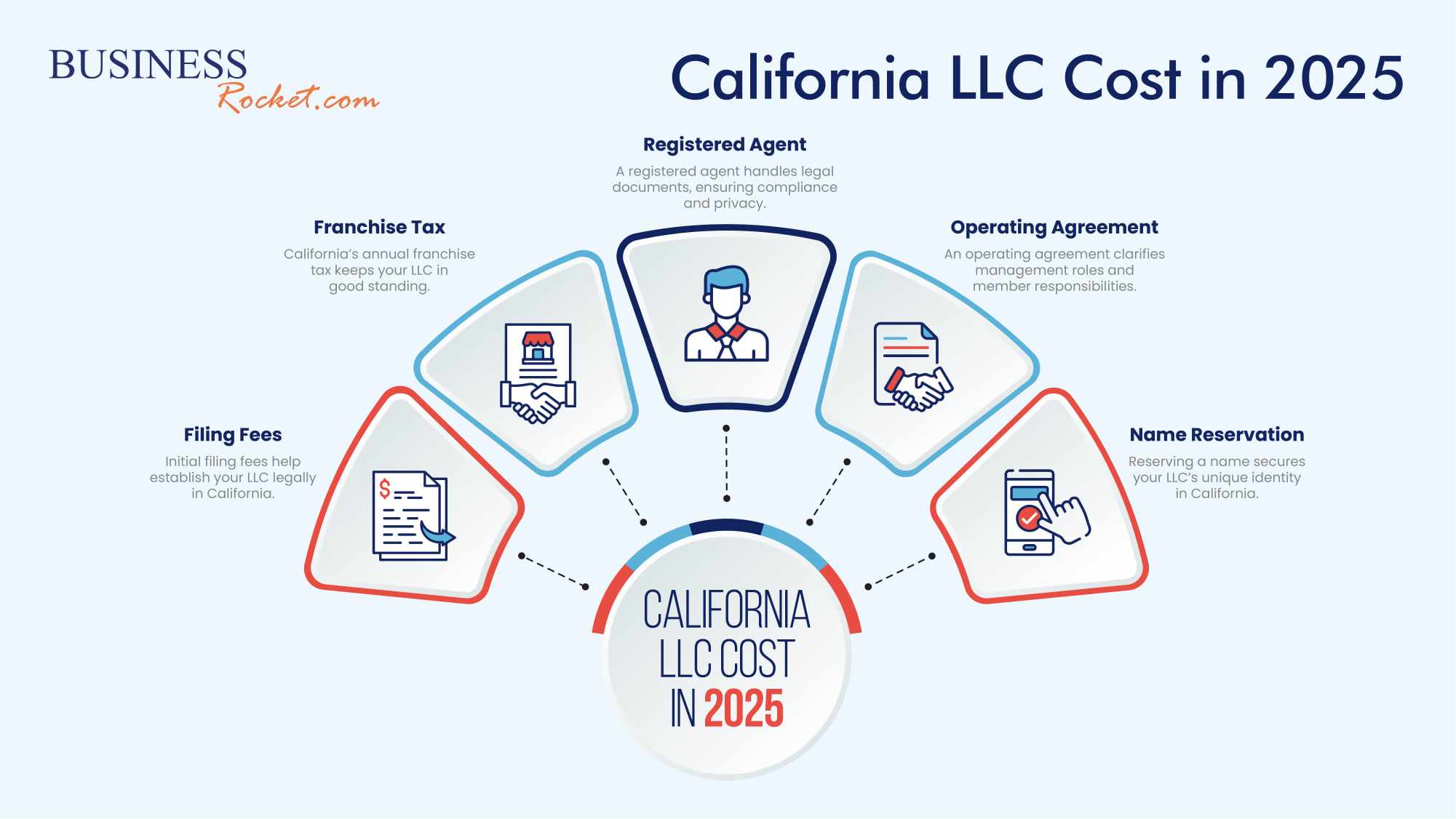
- Franchise tax in some states (California = $800/year minimum)
- Maintain separate business bank account
- Keep business and personal finances completely separated
- Document major business decisions
Administrative Burden: Moderate. More than sole proprietorship but far less than corporation.
Credibility & Professional Perception: LLC vs Sole Proprietorship
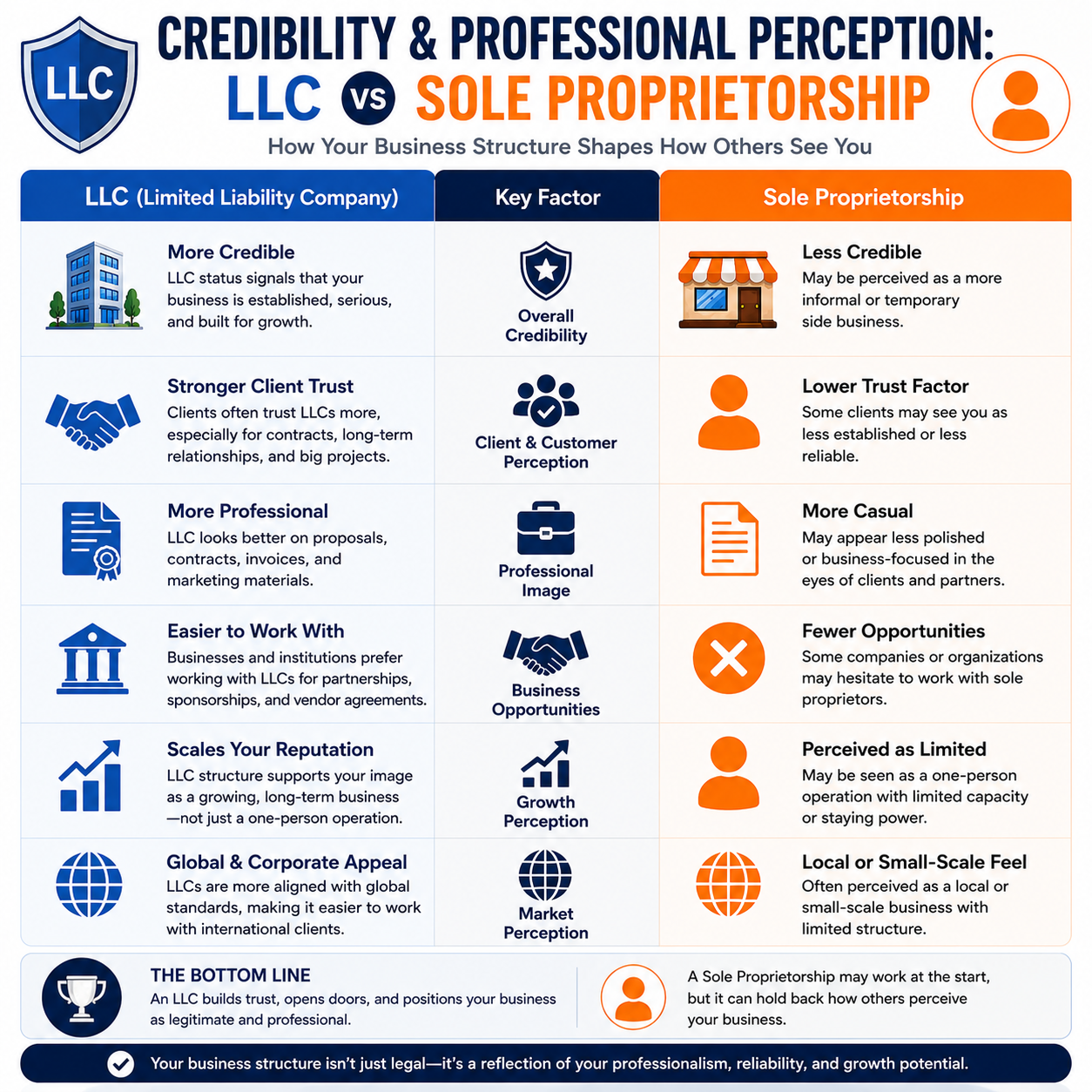
Professional appearance matters more than most business owners realize. The letters “LLC” after your business name change how clients, vendors, banks, and investors perceive you—often dramatically.
Professional Appearance Matters
LLC in your business name signals legitimacy to clients, vendors, and partners. Creates impression of established, professional operation rather than informal side hustle.
Client Perception Study Results:
- 67% of clients view LLC businesses as more trustworthy than sole proprietors
- 54% willing to pay 10-15% higher rates to LLCs versus sole proprietors
- 78% prefer working with registered business entities for contracts over $10,000
- 43% won’t work with sole proprietors at all for professional services
Why This Matters:
“John Smith Consulting” sounds like a guy with a laptop.
“Smith Consulting, LLC” sounds like a real company.
Same person. Same services. Completely different perception.
Vendor Terms and Relationships
Vendors may offer better payment terms to LLCs versus sole proprietors perceived as higher risk. Clients often prefer working with LLC-structured businesses for perceived stability.
Common Vendor Terms:
| Structure | Payment Terms | Credit Limit | Approval Rate |
|---|---|---|---|
| Sole Proprietorship | Pay upfront or COD | $500-$2,000 | 35% |
| LLC | Net-30 or Net-60 | $5,000-$25,000 | 72% |
Real Scenario:
Graphic designer needs to order $3,000 in printing for client project. As sole proprietor, printer requires 50% deposit upfront. As LLC, same printer offers Net-30 terms get paid by client before paying printer.
Funding and Investment Access
Banks and lenders strongly prefer lending to LLCs over sole proprietorships. According to Report on Nonemployer Firms, only 29% of nonemployer firms (majority sole proprietors) applied for financing, and just 31% were approved.
Why Lenders Prefer LLCs:
Separate Business Entity:
LLC has own legal existence, credit history, financial statements. Lender can evaluate business independent of owner’s personal situation.
Limited Liability Reduces Risk:
Owner has “skin in the game” but won’t walk away from business to protect personal assets as easily. LLC structure signals commitment.
Professional Structure:
LLC formation shows owner is serious, invested time/money in proper setup, more likely to succeed long-term.
Easier to Evaluate:
Business-specific financials, separate tax returns, clear ownership structure. Lender can assess business merit independently.
Loan Approval Rates:
| Business Type | Approval Rate | Average Amount |
|---|---|---|
| Sole Proprietorship | 31% | $15,000 |
| LLC | 68% | $45,000 |
| Corporation | 74% | $75,000 |
Why Such Different Rates?
Lenders view sole proprietors as “personal loans disguised as business loans.” One owner’s personal financial crisis destroys business. LLC has separate existence providing more stability.
Investor Attraction
Investors typically won’t invest in sole proprietorships at all. Equity investors need ownership stake in separate business entity impossible with sole proprietorship where business equals person.
Why Investors Require LLC or Corporation:
Ownership Structure:
Can’t buy 20% of “you” as a person. Can buy 20% membership interest in LLC. Clear ownership percentages, transferable interests.
Legal Protection:
Investor gets liability protection too. Their investment at risk, but personal assets protected from business liabilities.
Exit Strategy:
LLC can be sold, taken public, merged, acquired. Sole proprietorship dies with owner. No exit for investor.
Professional Standards:
Serious investors expect professional business structure. Sole proprietorship signals “hobbyist” not “scalable business.”
Investment Reality Check:
| Seeking | As Sole Proprietor | As LLC |
|---|---|---|
| $10K angel investment | 0% chance | 15% chance |
| $50K seed round | Not possible | 35% chance |
| $500K Series A | Never happens | 8% chance |
Contract Opportunities
Many corporations, government entities, and large businesses require vendors to be registered business entities.
Real Examples:
Government Contracts:
Most federal, state, local RFPs require registered business entity. Sole proprietors often disqualified automatically.
Enterprise Clients:
Fortune 500 companies typically require vendors carry certain insurance, maintain registered business status. Sole props can’t meet requirements.
Professional Services:
Law firms, accounting firms, consulting firms often prohibited by insurance/policy from contracting with sole proprietors for certain work.
Lost Opportunities:
Sole proprietor loses $50,000 consulting contract because client requires LLC for insurance purposes. LLC formation costs $300. $50,000 revenue lost over $300 decision.
Professional Licensing and Memberships
Some industries require or strongly prefer LLC structure:
Real Estate:
Many states require real estate investors/flippers operate as LLC or corporation for licensing.
Construction:
General contractor licenses often require business entity registration. Sole proprietor may not qualify for certain license levels.
Professional Organizations:
Some trade associations offer better membership tiers, benefits, networking to registered entities versus sole proprietors.
Business Growth & Exit Strategy
Sole proprietorships die when owner retires, becomes disabled, or passes away. Cannot transfer or sell business easily since business IS the owner personally.
LLCs continue existing regardless of ownership changes. Can sell your membership interest, bring on partners, transfer to family members, or structure buyout agreements. Creates actual business value separate from you personally.
Exit Scenarios:
Sole Proprietor Retirement:
- Business value: $0 (knowledge/skills in owner’s head)
- Clients likely leave when owner exits
- No transferable asset to sell
- Lifetime of work produces no sellable entity
LLC Retirement:
- Business value: $100K-$500K+ (depending on revenue, systems)
- Can sell to competitor, employee, family member
- Systems, client lists, processes have value
- LLC continues operating under new ownership
- Owner receives payout for lifetime of work
Succession Planning:
Sole Proprietorship:
Dies with owner. Estate gets whatever cash in bank account. Client relationships vanish. No ongoing income for heirs.
LLC with Operating Agreement:
Ownership transfers to designated successor. Business continues. Revenue continues. Family receives ongoing income or can sell business for lump sum.
Bottom Line: LLC structure opens doors sole proprietorships can’t access. Higher credibility, better vendor terms, easier funding, investor attraction, contract opportunities, and real exit value. The $300 formation cost returns itself many times over through these advantages.
State-by-State LLC Formation Costs: Where Formation Is Cheapest (2026)
LLC costs and requirements vary dramatically by state. Here’s the complete breakdown showing cheapest to most expensive states for forming and maintaining an LLC.
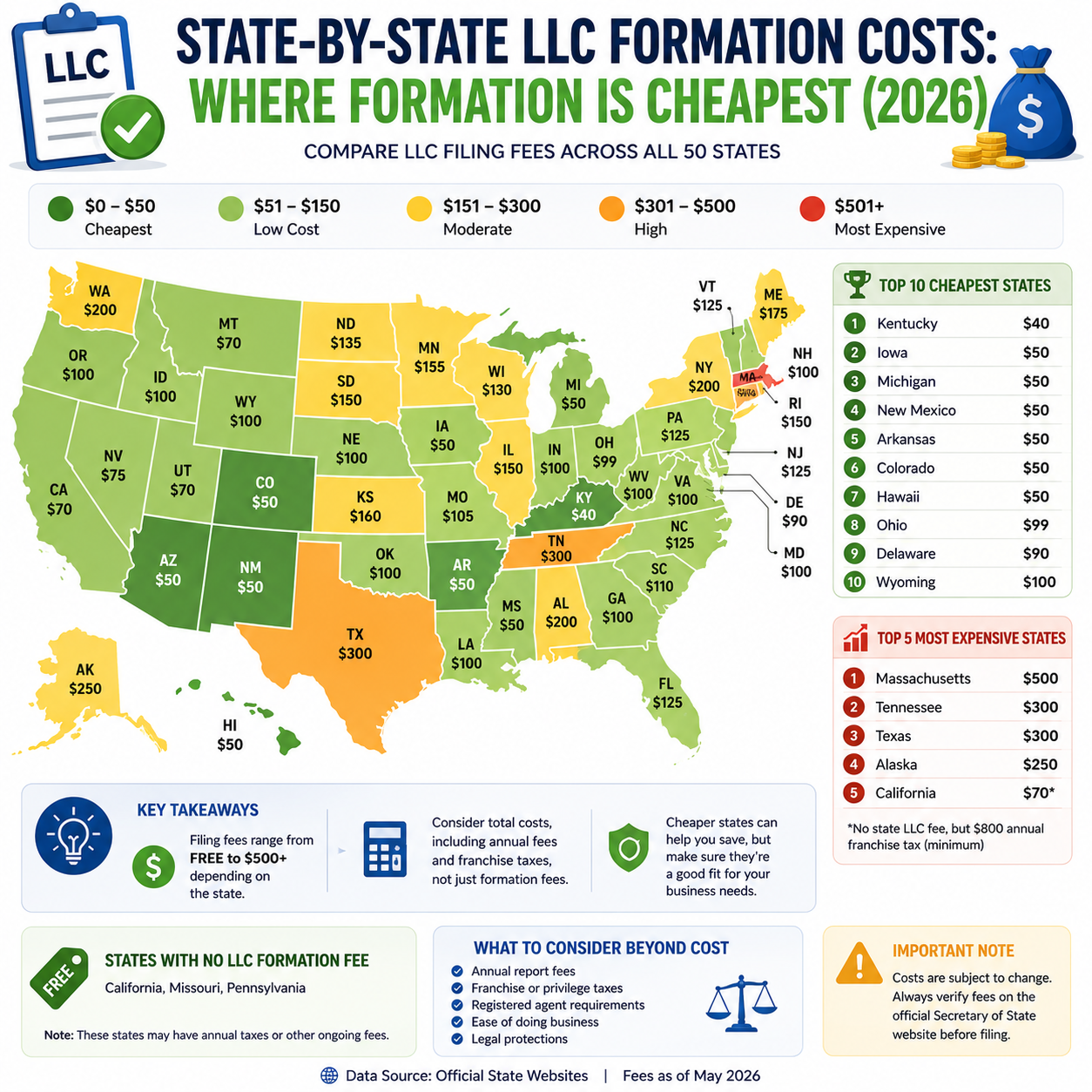
Cheapest States to Form LLC
1. Montana
- Formation fee: $35 (lowest in nation)
- Annual report: $20 ($0 waived 2026-2027 if filed on time)
- Franchise tax: $0
- 5-year total: $75
2. Kentucky
- Formation fee: $40
- Annual report: $15
- Franchise tax: $0
- 5-year total: $115
3. Mississippi
- Formation fee: $50
- Annual report: $0 (free for domestic LLCs)
- Franchise tax: $0
- 5-year total: $50
4. Arizona
- Formation fee: $50
- Annual report: $0
- Franchise tax: $0
- 5-year total: $50
5. Wyoming
- Formation fee: $100
- Annual report: $60
- Franchise tax: $0
- 5-year total: $400
Most Expensive States to Form LLC
1. Massachusetts
- Formation fee: $500
- Annual report: $500
- Franchise tax: $0
- 5-year total: $3,000
2. Nevada
- Formation fee: $425
- Annual report: $350
- Business license: $200
- 5-year total: $2,225
3. California
- Formation fee: $70
- Franchise tax: $800/year (minimum, regardless of profit)
- Annual filing: $20
- 5-year total: $4,170
4. Illinois
- Formation fee: $150
- Annual report: $75
- Franchise tax: $300+ (based on capital)
- 5-year total: $1,650+
5. Delaware
- Formation fee: $90
- Franchise tax: $300/year
- Registered agent: $50/year required
- 5-year total: $1,790
Best States for Different Situations
For Lowest Cost:
Montana, Mississippi, Arizona ($50-$75 five-year total)
For Privacy:
Wyoming, Nevada, Delaware (don’t require member names public)
For No State Income Tax:
Wyoming, Nevada, Texas, Florida, South Dakota
For Online Businesses:
Any state (you’re not physically operating there anyway)
For Real Estate:
Wyoming (no franchise tax, cheap annual fees, privacy)
Bottom Line: State choice can cost you $50 or $4,000+ over 5 years. Choose based on where you actually operate OR where costs/benefits align with your needs.
When to Choose Sole Proprietorship for Your Small Business
Sole proprietorship makes sense when choosing between a sole proprietorship and LLC if you’re:
✓ Testing a business idea before full commitment
✓ Running very low-risk venture unlikely to generate lawsuits
✓ Earning minimal income (<$10,000-$20,000 annually)
✓ Operating short-term project or seasonal business
✓ Prioritizing absolute simplicity over all factors
✓ Have minimal personal assets requiring protection
✓ Carrying comprehensive liability insurance covering realistic risks
Perfect sole proprietorship candidates: Freelance writer with no client meetings, online affiliate marketer, hobby business testing market demand, part-time tutor working from client locations.
When to Choose LLC for Your Right Business
Start an LLC if your right business involves:
✓ Meeting clients in person at your location
✓ Selling physical products
✓ Using vehicles for business purposes
✓ Hiring employees or contractors
✓ Operating from commercial space
✓ Accumulating business debts/loans
✓ Providing professional services
✓ Earning $40,000+ annually (for S-Corp tax savings potential)
✓ Wanting to appear professional and established
✓ Planning long-term business growth
✓ Having significant personal assets to protect
Perfect LLC candidates: Marketing consultant meeting clients, e-commerce business selling products, landscaping company with vehicles/equipment, coaching business with employees, restaurant/retail location, contractor/service provider carrying business loans.
Form an LLC as soon as your business generates real income, serves clients, or carries any liability exposure.
Freelancer’s Guide:
Most freelancers start simple. A sole proprietorship. No cost. No setup stress. Just work and earn. But at some point, things shift a little. Income grows. Clients get bigger. Risk starts to feel real.
Stay Sole Proprietorship If You’re:
✓ Earning under $30,000/year
Early stage freelancing. Keeping things simple makes sense. LLC costs don’t really pay off yet.
✓ Doing part-time freelancing
Side income after a job. No pressure to formalize everything right now.
✓ Offering low-risk services
Writing, basic design, data entry. Very low chance of legal issues.
✓ Working through platforms only
Upwork, Fiverr, agencies. They already manage most client relationships.
✓ No team involved
Just you. No employees. No extra liability in the picture.
Switch to LLC When You Hit These Milestones:
✓ Income crosses $40,000/year
Now tax savings start to matter. An LLC with S-Corp option can actually save real money.
✓ Enterprise clients enter the picture
Big companies prefer registered businesses. LLC feels more “official” to them.
✓ Projects reach $10,000+ value
One dispute on a large contract can become a real financial risk.
✓ You start hiring help
Virtual assistants or freelancers change the game. Liability expands quietly.
✓ Work involves risk-heavy services
Web bugs, marketing claims, consulting advice, copyright work—things can get complicated.
Key Takeaways: Choosing the Right Business Structure
Liability Protection Is Everything:
- Sole proprietorship = unlimited personal liability, all assets at risk
- LLC = limited liability protection, only business assets exposed
- LLC formation cost ($100-$500) tiny compared to potential lawsuit losses
Tax Simplicity vs Flexibility:
- Both are pass-through entities by default
- Sole proprietorships stuck with simple Schedule C filing
- LLCs can elect S-Corp status saving thousands in self-employment tax
Formation Effort Trade-Off:
- Sole proprietorship = zero paperwork, instant start a business
- LLC = 30-60 minutes online filing, ongoing annual compliance
Professional Credibility:
- Sole proprietorships appear informal, harder to get funding
- LLCs signal legitimacy, improve lender/investor access
Growth & Exit Options:
- Sole proprietorships die with owner, difficult to transfer
- LLCs continue existing, can add partners, sell membership
The Decision Framework:
- Start a business as sole proprietorship if testing idea with minimal risk/income
- Form an LLC once business generates real revenue or any liability exposure
- Don’t let $100-$500 LLC formation cost prevent protecting assets worth $100,000+
Bottom Line: Most serious businesses should start an LLC from day one. The liability protection alone justifies formation costs. Sole proprietorships work for very low-risk testing phases only.

 How to start Freelancing – Tips August 22, 2026 - Home » Sole Proprietorship vs LLC: Key Differences (2026)How to Start Freelancing – 9 Proven Tips for Beginners To start freelancing, you must have a digital skill first. Because if you don’t have any online skill, you can’t give any service to your clients, and you also can’t make an account on any freelancing platform …
- How to start a transportation business August 20, 2026 - Home » Sole Proprietorship vs LLC: Key Differences (2026)How to Start a Transportation Business in 2026 Learn how to start a transportation business in 2026 with our simple 11-step guide. Covers costs, USDOT and MC permits, insurance, vehicles, and more. Start your Career Today Trustpilot Register Your Business Table of Contents How to Start a …
 How To Start a Handyman Business August 19, 2026 - Home » Sole Proprietorship vs LLC: Key Differences (2026)How to Start a Handyman Business in 2026 To start a handyman business, first research your local state and city licensing limits, register your business structure, and buy general liability insurance. Start your Career Today Trustpilot Register Your Business Table of Contents How to Start a Handyman …