How Texas LLC Services Help You
Error-Free Registration: They act as a helping hand to ensure your new company is registered perfectly the first time.
Asset Protection: They create a legal wall to separate personal assets (like your home) from business debts.
Startup Support: Specifically designed for entrepreneurs and startups who want to avoid legal mistakes.
Expert Guidance: Professional teams handle the paperwork so you can focus on growing your brand.
Texas LLC formation services play a quiet but influential role in modern business formation. In the U.S., most new entities are now created online, and accuracy matters more than speed. We use these services to reduce errors, save hours, and stay aligned with state rules. The result feels lighter and ready to move forward.
A Texas LLC is a Limited Liability Company designed to separate personal and business responsibility. You operate under a flexible structure while your personal assets stay protected. Say an issue lands on the business, liability stops at the company level, not your home or savings. That balance helps llc members focus on growth with confidence.
A trusted business formation service keeps compliance steady from day one. We see fewer missed notices, cleaner records, and smoother reporting. For first-time founders, it removes guesswork when you start your llc, especially if you’re expanding from another state or choosing reliable online llc services built for service in texas.
Texas LLC Formation : Step-by-Step Guide
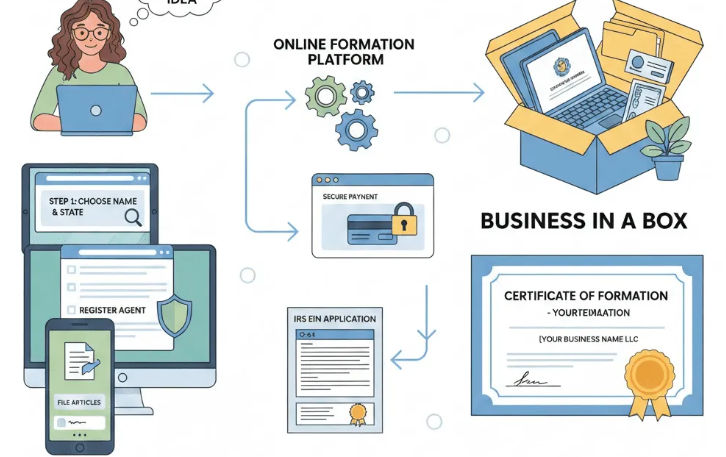
Creating a Texas LLC with professional LLC formation services is about structure, not stress. When we start an LLC, we’re turning an idea into a real business in Texas with legal standing and clarity. The goal is simple: liability protection and long-term stability. Whether it’s a growing team or a single-member LLC, these services help separate personal life from business responsibility while ensuring the foundation stays solid from day one.
The journey to form your LLC follows a clear path that supports growth and compliance. Each step works together, from naming to governance, so nothing feels rushed or uncertain. A well-prepared LLC operating agreement sets expectations early and keeps operations smooth. When we form your LLC the right way, the business runs cleaner, decisions feel easier, and the structure stays ready for what’s next.
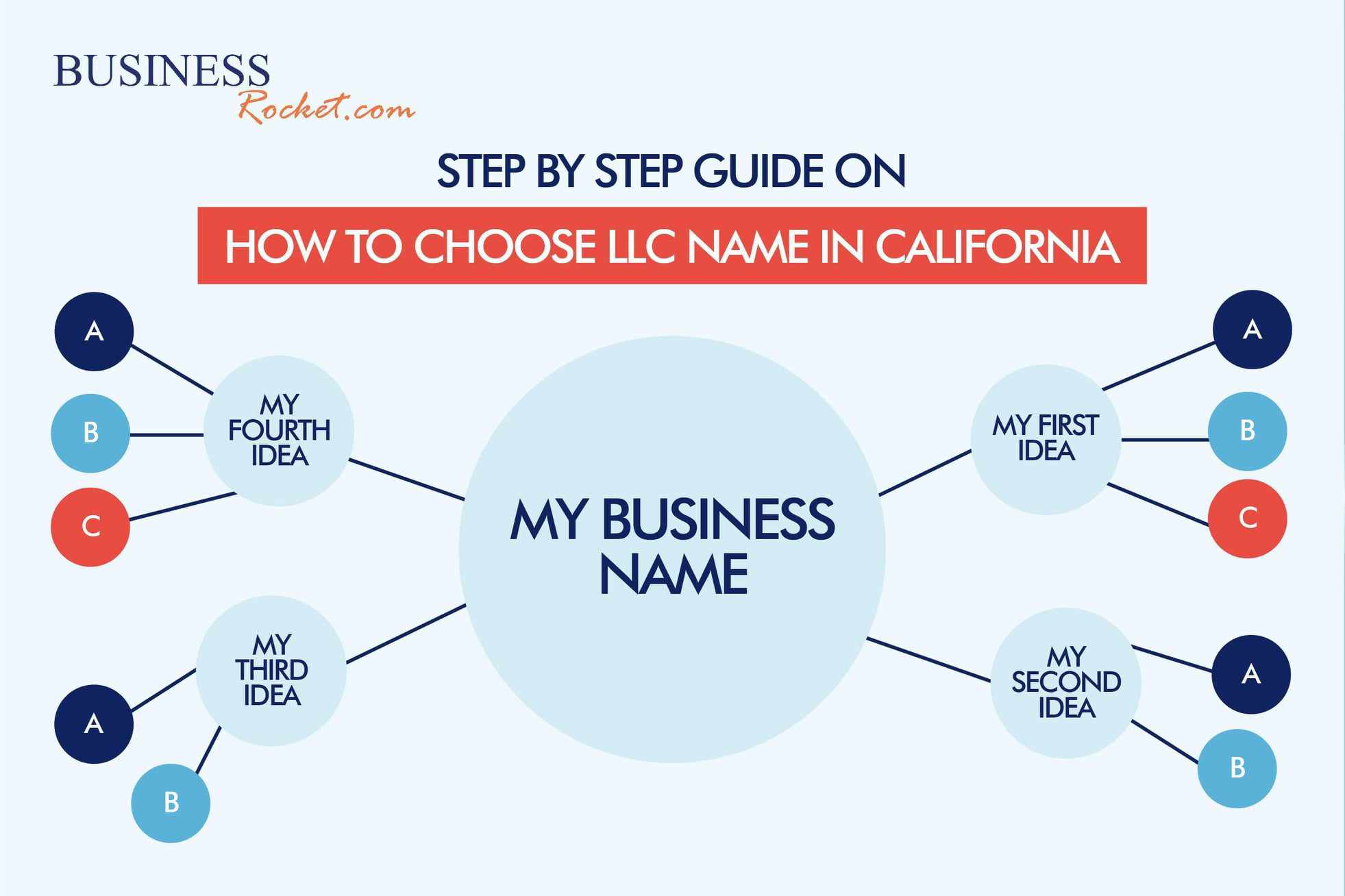
Step 1: Choose the best Name for Your LLC
- Go to Texas Secretary of State-SOSDirect, start with a name that reflects your brand and future direction
- Make sure it’s unique among existing Texas business entities
- Follow Texas naming rules so approval isn’t delayed
- A clean name builds trust with banks, partners, and customers
Step 2: Select Texas in State
- Choosing Texas means your LLC follows Texas business laws
- The state you form in controls compliance and reporting rules
- Texas is ideal if operations or owners are based locally
- Oversight comes from the Texas Secretary of State, keeping records official and public.
Step 3: File Articles of Organization
- This filing officially brings your LLC into existence
- It creates a separate legal identity for the business
- Once approved, the LLC can operate independently of its owners
- Accuracy here avoids rejections and unnecessary delays.
Step 4: Registered Agent selection
- Every Texas LLC must list a registered agent
- This role receives legal notices and official state documents
- A physical Texas address is required by law
- Choosing the right agent keeps communication reliable
Step 5: Create an Operating Agreement
- This document explains how the LLC runs internally
- It defines ownership percentages and decision authority
- Clear rules reduce misunderstandings between members
- It supports long-term stability, even as the business grows
Step 6: Apply for an EIN
- An EIN identifies the LLC at the federal level
- It’s needed for banking, payroll, and formal reporting
- This step separates personal identity from business activity
- It connects the LLC to national systems cleanly
Step 7: Comply With Texas State Tax Requirements
- Ongoing compliance keeps the Texas LLC active
- State and federal registration protect good standing
- Staying organized prevents interruptions later
- Consistency here supports smooth, confident growth
This process isn’t about doing more. It’s about doing things right, once, and building forward with confidence.
Legal Requirements to Form an LLC in Texas
Registered Agent Requirements for Texas LLCs
Every limited liability company in Texas must designate a registered agent, the official point of contact for service of process and legal documents. This isn’t optional. State law mandates it before your LLC gains legal recognition. The registered agent receives lawsuits, tax notices, and government correspondence when your LLC is sued or contacted by authorities.
Legal Requirements
Physical Texas Address Required: Your Texas registered agent must maintain a street address (not a P.O. Box) with an office in Texas during standard business hours to handle formation and compliance matters.
Individual or Entity Eligibility: Can be a Texas resident, the LLC owner themselves, or a business entity authorized to provide registered agent services in the state of Texas. Many legal services like Business,Rocket, offer this designation.
Availability Mandate: Must be present at the registered office address during regular business hours to accept legal documents, official correspondence, and notices from the Texas Comptroller.
Continuous Designation: Your LLC must always have an active registered agent on registration with the Texas Secretary of State; any lapse during the llc formation process or afterwards violates state compliance requirements.
Official Record Keeping: Agent information appears on your certificate of formation and must be updated whenever changes occur through proper state submission procedures, whether you’re forming a limited liability company or maintaining an existing one.
Comparing the Best LLC Services in Texas
When evaluating best LLC services in Texas, focus on what you’re actually getting, not marketing promises. Smart comparison means examining pricing transparency, included features, and ongoing support. Here’s how to assess which service offers align with your needs as you start a limited liability company.
Service Comparison Framework
Compare providers across these critical factors:
Pricing structure:
- Base formation fee (beyond $300 state filing)
- What the basic formation package actually includes
- Hidden costs for “essential” features marketed as add-ons
- Renewal pricing for registered agent after first year
Formation package contents:
- Year of registered agent service included
- Operating Agreement preparation
- EIN application assistance
- Compliance calendar and annual reporting reminders
- Customer support access (chat, phone, email)
Support quality:
- Response time for customer inquiries
- Availability (business hours only vs. extended support)
- Knowledge level of support staff
- Educational resources and guidance materials
Compliance tools:
- Automatic deadline reminders for report with the texas comptroller
- Document storage and access
- State fee payment handling
- Ongoing formation and compliance monitoring
Texas LLC Service Comparison
| Feature | BusinessRocket ⭐ | ZenBusiness | LegalZoom | Northwest | IncFile |
|---|---|---|---|---|---|
| Base Price | $0 + state fees | $0 + state fees | $149 + state fees | $39 + state fees | $0 + state fees |
| Total First Year Cost | $300 | $300 | $448+ | $339+ | $370+ |
| Operating Agreement | ✅ Included | ✅ Included | ❌ $99 add-on | ❌ $99 add-on | ❌ $99 add-on |
| EIN Assistance | ✅ Included | ✅ Included | ✅ Included | ✅ Included | ❌ $70 add-on |
| Year 1 Registered Agent | ✅ Included | ✅ Included | ❌ $299/year | ✅ Included | ✅ Included |
| Annual Compliance Reminders | ✅ Lifetime free | ✅ Automated | ⚠️ Premium only | ⚠️ Basic only | ⚠️ Paid upgrades |
| Customer Support | ✅ Phone, chat, email (priority) | Chat, email | Phone, chat, email | Phone, email | Email, chat |
| Document Storage | ✅ Lifetime access | Limited time | Premium plans | Basic access | Limited |
| Educational Resources | ✅ Comprehensive guides | Moderate | Extensive (paid) | Limited | Basic |
| Hidden Fees | ✅ None | Renewal upsells | Multiple add-ons | Service fees | Many add-ons |
| Money-Back Guarantee | ✅ 100% satisfaction | 60 days | 60 days | 60 days | None |
| Processing Time | ⚡ Same-day submission | 1-2 days | 1-3 days | 2-3 days | 2-4 days |
| Best For | All business owners—complete value | Simple formations | Legal consultation needs | Budget minimalists | DIY comfortable users |
BusinessRocket delivers unmatched value by including everything you need to start without hidden costs. While competitors advertise “$0 formation,” they charge separately for Operating Agreements ($99), EIN assistance ($70), and registered agent renewals ($299/year). BusinessRocket bundles these essentials at no extra charge.
Texas LLC Filing Fees and State Costs
The Texas Secretary of State charges a mandatory state submission fee of $300 to process your Certificate of Formation. This LLC formation fee is non-negotiable, every business must pay it when filing the certificate of formation, whether you register online or by mail. No hidden costs here. Just one straightforward submission fee to make your limited liability company in Texas official.
Required and Optional State Fees
| What You Pay For | Amount | When It’s Due |
|---|---|---|
| Certificate of Formation filing | $300 | When you submit your LLC registration |
| Expedited state processing | $25 | With submission (optional) |
| Name reservation | $40 | Before submission (optional) |
| Certified copy of formation | $15 | After approval (optional) |
| Certificate of Status | $5 | When proof is needed (optional) |
The simple takeaway:
The $300 state submission fee is the only mandatory cost to make your limited liability company in Texas official. Everything else is optional and requested only if you need extra documents or faster processing.
Whether you register on your own through online submission or use professional LLC services, the state fee stays the same. The difference is convenience, not legality.
Texas Franchise Tax and Ongoing Tax Obligations
Forming your LLC is step one. Staying compliant? That’s the long game. The Texas Comptroller of Public Accounts oversees tax compliance for all Texas businesses, including franchise tax requirements. Don’t panic, most small LLCs owe nothing. Here’s what you actually need to know about annual reporting and Texas franchise tax obligations after you start your business.
Understanding Texas Franchise Tax
The Texas franchise tax is an annual privilege tax for doing business in the state of Texas. It’s calculated on your company’s revenue, not profit. Here’s the relief: LLCs generating under $2.47 million annually owe zero franchise tax. You still file the report with the Texas Comptroller, you just pay nothing.
Key franchise tax facts:
- Revenue threshold – Under $2.47 million = $0 tax owed (covers most small businesses)
- Filing requirement – All LLCs must file annually, even if owing nothing
- Due date – May 15th each year without exception
- Who must file – Every Texas LLC, including out-of-state LLC entities with Texas operations
- Penalties – Missing deadlines risks losing good standing status, blocking you from obtaining a general business license
Filing proves you’re maintaining formation and compliance standards. The Texas Comptroller of Public Accounts makes this process straightforward through free online tools.
Federal Tax Requirements: The EIN
Your EIN (Employer Identification Number) serves as your federal tax ID. Nearly every Texas LLC needs one. You’ll use it to open a business bank account, hire employees, and File federal returns.
When you need an EIN:
- Opening business bank accounts or credit lines
- Hiring employees or independent contractors
- Filing federal tax returns for multi-member LLCs
- Adding credibility when you start a texas business
Exception: Single-member LLCs without employees can sometimes use your social security number instead, but getting an EIN is free and recommended.
The llc structure determines federal tax treatment. Most Texas LLCs operate as “pass-through” entities, profits flow directly to your personal tax return. No corporate double taxation. Texas franchise tax goes to the state comptroller. Federal income tax goes to the IRS. Completely separate systems with different deadlines.
Managing Your Annual Obligations
Tax compliance for small LLCs is simpler than you’d expect. The no-tax threshold means most businesses file a simple zero-balance report online in under 15 minutes.
Staying compliant made easy:
- Set reminders – Mark May 15th for franchise tax filing
- Use free tools – The Texas Comptroller of Public Accounts provides webfile access
- Track revenue – Know if you’re approaching the $2.47 million threshold
- Maintain records – Keep documentation for annual reporting requirements
- Consider support – Many best llc formation services include automatic filing alerts in their additional services packages
Whether your llc formation package includes accounting support through legal services or you handle annual reporting independently, the process becomes routine after your first year. You can stay organized, File on time, and your formation and compliance obligations won’t interrupt your actual business operations. That’s the goal: spend less time on paperwork, more time growing what you started your business to build.
Series LLCs in Texas: Benefits and Use Cases
A Series LLC operates like one parent company with multiple independent “children” underneath. Texas law allows this unique structure where each series maintains separate assets, liabilities, and operations, all under one master LLC umbrella. Think of it as creating mini-LLCs in Texas without filing separate formations for each. Popular among real estate investors? Absolutely. Right for every business? Not even close.
Advantages of Series LLCs
- Asset Protection Multiplied, each series shields assets from the others’ liabilities. One rental property gets sued? Other properties in separate series remain protected, unlike a standard single LLC structure.
- Cost Efficiency – Pay one formation fee to the state instead of multiple $300 filings. Use one texas registered agent service for the entire structure rather than separate agents for each property when you start a limited liability company.
- Simplified Administration – File one report with the texas comptroller annually covering all series. Maintain one operating agreement (though each series can have distinct management rules for how the llc is managed).
- Scalability for Growth – Add new series without additional state filings. Real estate investors can acquire properties continuously and drop each into a fresh series for instant liability separation.
Disadvantages and Limitations
- Banking Complications – Many Texas banks don’t recognize series as separate entities. Opening individual accounts for each series becomes challenging, limiting the practical separation you’d expect.
- Legal Uncertainty – Texas law recognizes series, but federal courts and other states have mixed track records. If you operate across state lines or face federal litigation, protection becomes murky.
- Not Suitable for All Industries – Service businesses, retail operations, or ventures without distinct asset pools gain minimal benefit. The complexity outweighs the advantages unless you’re managing multiple high-value, liability-prone assets.
Real Estate Investing Example
Take Maria. She owns five rental properties in Austin. The usual route would mean setting up five separate LLCs, paying $300 each, working with five registered agents, and handling five annual filings. Instead, she chooses a Series LLC. One master LLC. One agent. One yearly report. She creates Series A through Series E, each with a single property.
A tenant in Series C slips and files a lawsuit. Only that property is at risk. The rest of her rentals stay untouched. When Maria buys another property, she simply adds a new series; no extra state filing is needed. It’s efficient. It scales well.
There are tradeoffs. Some banks aren’t comfortable with series structures. Accounting takes a bit more work. But for someone managing a growing portfolio, the setup fits.
Bottom line: Series LLCs in Texas make sense for real estate investors, equipment leasing businesses, or anyone managing three or more separate asset groups. If you’re running a single property or one core asset, a standard LLC keeps things simpler.



 How to start Freelancing – Tips August 22, 2026 - Home » Texas LLC Formation Services in 2026How to Start Freelancing – 9 Proven Tips for Beginners To start freelancing, you must have a digital skill first. Because if you don’t have any online skill, you can’t give any service to your clients, and you also can’t make an account on any freelancing platform because …
- How to start a transportation business August 20, 2026 - Home » Texas LLC Formation Services in 2026How to Start a Transportation Business in 2026 Learn how to start a transportation business in 2026 with our simple 11-step guide. Covers costs, USDOT and MC permits, insurance, vehicles, and more. Start your Career Today Trustpilot Register Your Business Table of Contents How to Start a Transportation …
 How To Start a Handyman Business August 19, 2026 - Home » Texas LLC Formation Services in 2026How to Start a Handyman Business in 2026 To start a handyman business, first research your local state and city licensing limits, register your business structure, and buy general liability insurance. Start your Career Today Trustpilot Register Your Business Table of Contents How to Start a Handyman Business …